Friday, 18 October 2013

New archive intern, new photo discoveries!


Hello,

My name is Sharon and I’m the new archive intern. I completed the MSc in Information Management and Preservation at the University of Glasgow in August of this year and I’m very excited to begin to get practical experience working as an archivist. It’s also very nice to return to LHSA; this is where I did my course cataloguing placement last year.

My main task is to continue cataloguing LHSA’s collection of photographs into the database, so my first week has been spent mainly assessing them and making a list of what we have. The internship also allows me to experience other aspects of archival work, including dealing with enquiries. Sarah, the Conservation Intern and I helped Archive Assistant Stephen research some enquiries from the public by looking through the Royal Edinburgh Hospital Register of Deaths and the Casebooks. I’ve also been helping Archivist Laura to make arrangements for the ‘200 years 200 Objects’ exhibition which will be taking place at the Talbot Rice Gallery next month. Yesterday we spent some time evaluating objects and papers from our collection which will form part of the exhibition and I had the opportunity to see important historical resources such as the Royal Edinburgh Hospital Minute Books.

I’ve seen a lot of really interesting photographs this week and am sharing my favourite one so far. This is a so far uncatalogued item entitled ‘Photos in Nurseries, June 1949’. It shows children from St Kentigern's; I don't know much about its provenance nor about its context, but the delight on the faces of the nurses and children and the penguins, happy to be the centre of attention, make it a great photograph.
St Kentigern's children with penguins, 1949

Friday, 11 October 2013

Physician to the King


This week’s blog focuses on the papers of the famous surgeon Sir James Rögnvald Learmonth (1895 – 1967) which are currently being catalogued by archive assistant Stephen.

Learmonth was born in Kirkcudbright and graduated from the University of Glasgow in 1921. In 1924 he was awarded a Rockefeller medical scholarship and spent a year at the Mayo Clinic in Minnesota. Learmonth was later invited to go back to the Mayo clinic as a permanent member of the clinical staff from 1928 – 1932. Returning to Scotland in 1932, he was appointed as regius professor of surgery at the University of Aberdeen - the professorship selected by the King. In 1939, he was appointed professor of surgery at the University of Edinburgh and in 1946, regius professor of clinical surgery. This meant that he could be called upon to treat the King, particularly when he visited Scotland. Therefore, from 1932 Learmonth started keeping newscuttings of George V and later George VI (there is no mention of Edward VIII), charting some of their health problems. In 1949 Learmonth conducted a lumber symphathectomy on George VI to improve blood supply to the monarch’s foot. For this, Learmonth was made Knight Commander of the Royal Victorian Order (KCVO) and the collection includes copies of letters written by George VI and his wife Queen Elizabeth, thanking him for his help.
 
Learmonth, centre, at Association of Surgeons of Great Britain and Ireland, April 1955
After George VI died in 1952, Learmonth continued to be available for service to Elizabeth II and was appointed an extra surgeon to the Queen in Scotland from 1960. One of the cuttings books contains an invite to the wedding of Princess Elizabeth to Phillip Mountbatten in 1947, now Queen Elizabeth II and Prince Phillip. Other cuttings and photographs present include Learmonth’s visits to Norway and France for medical conferences, and obituaries relating to colleagues.
 
Royal wedding order of service, 1947
In his later years, Learmonth was greatly respected by the medical community and some of the papers include details of visits to New Zealand and Canada in 1954 to inspect medical facilities. The April 1967 edition of Mayo Alumnus, included in this collection, contains a series of correspondences between Learmonth and the editor where he offers to write an article on his scientific philosophy though he thinks it ‘would be a trifle old-fashioned’ since he has been retired for ten years. The editor assures him that what he says will be read with interest and Learmonth’s article follows in that edition. Learmonth was diagnosed with lung cancer and passed away on 27 September 1967, but his legacy remains in his papers (Acc 06/15) and case notes held at LHSA.

Friday, 4 October 2013

On the horizon...

We’re delighted to be welcoming two new interns to the LHSA team next week. Our second round of internships will follow a similar programme to those that we ran earlier in the year, providing project based work to help the interns expand their skills after qualifying along with some wider experience of working in the archive sector too.

We’ll also be carrying out the informal interviews for a brand new research based internship next week. This is an exciting time - seeing increased work on LHSA material and giving us an opportunity to pass on some of our experience and knowledge of both the collections and the archive/conservation fields to those new to the profession.

We’ve recently added a photo journal to our Flickr stream to represent some of the work of our first two interns, Fiona and Charlotte(http://www.flickr.com/photos/49439570@N08/sets/72157635875916173/). We’re looking forward to seeing more of the same for this round and our interns will be blogging regularly, so watch this space!

Friday, 27 September 2013

Dott the draughtsman...


This week, our Project Archivist, Louise, talks about Norman Dott’s skill in draughtsmanship…
As I look through Norman Dott’s neurosurgical case notes, the many different ways of conveying information, diagnoses and treatment methods never fail to amaze me. From the typed case summaries and charts that you might expect from loose-leaf case notes in this period, folders can contain photographs, x-rays, greetings cards, slides, off-prints and press cuttings.

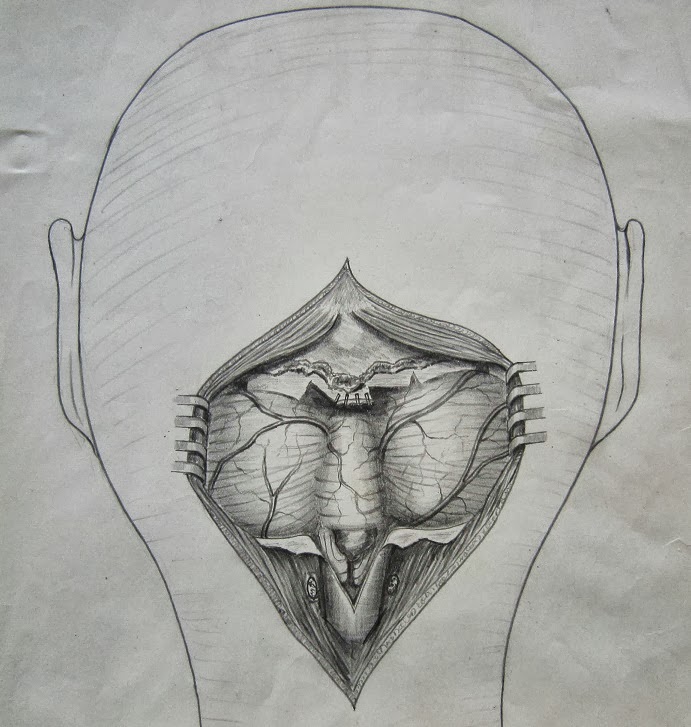
Some of my favourite things to find in the case notes are surgical sketches, uncovering Dott’s methods in visual form. Some sketches were made by professional artists for use in publication or clinical demonstration, and you may recognise some of the examples below from the LHSA website:


LHB1 CC/20/PRI.682 – artist sketch showing operation for removal of cyst


Artist sketch showing ligature of intracranial aneurysm (from LHSA Norman Dott clinical drawing collection)

The visual communication of his specialism for learning and teaching purposes was obviously very important to Dott: he planned Ward 20 in the Royal Infirmary of Edinburgh (which was to become Scotland’s first dedicated neurosurgery ward, opening in 1938) with artist and photographic studios. However, behind many of the surgical sketches made by artists were drawings made by Dott himself, both as templates for artists to make more detailed representations and for consultation in their own right. Before a motorcycle accident led him to pursue a medical career, Dott was to begin an apprenticeship as an engineer, and perhaps this led to his fondness for using sketches in clinical notes. This drawing demonstrates a procedure for which Dott was a pioneer, in the treatment of intracranial aneurysm by the application of a ligature:

LHB1 CC/24/PR2.3601 (patient details have been redacted)

Whereas this sketch portrays the approach to removing a brain tumour from a young patient:


LHB1 CC/20/PR1.289

Dott was an assiduous record-keeper, not only keeping meticulous clinical notes that were frequently complimented by his peers, but preserving information related to his patients in many forms, from cards sent in thanks from grateful patients to handwriting samples and articles clipped from newspapers. Dott’s own sketches are an essential part of his substantial clinical archive, explaining in visual form the progression of his thoughts and his perception of the life-threatening illnesses which he so often encountered.

Friday, 20 September 2013

Audience engagement

How we communicate the importance of our collections, their relevance to a worldwide audience, and promote access to them is a key part of our work. This month has seen lots of activity on that front with exhibitions, talks and filming all taking place and helping to bring LHSA into contact with people from many walks of life. Keep a look out for us over the coming weeks!

Patient artwork from the Royal Edinburgh Hospital (REH) is featuring in two exhibitions – one at the Djanogly Art Gallery in Nottingham, the other at Halle St Pierre in Paris, and reproductions of this artwork are due to feature at the Scottish Mental Health Art and Film Festival at Summerhall, Edinburgh, from 5 to 19 October.

‘Melancholia’ by John Willis Mason, copy on show at Summerhall in October

The Wellcome Trust (WT) has interviewed researcher Dr Gayle Davis about her work on infertility case notes held at LHSA, conserved with WT funding. The film will be available on their website. Next week, items from the REH will be the subject of a three-part series of BBC Radio Scotland interviews, to be broadcast in November, to commemorate the Hospital’s bicentenary.

Archivist Laura has been talking about the history of the Royal Infirmary of Edinburgh’s finances from its beginnings in the 1720s, until the introduction of the NHS in 1948, to former employees of the Bank of Scotland. Today she is talking about the Archive’s use of social media in engaging audiences to an Archives and Records Association Training Day in Aberdeen, ensuring that we share best practice with colleagues in the archive sector, and learn from them too.

Friday, 13 September 2013

Dispensing hope

Following on from a number of blogs on the treatment of Tuberculosis (TB), this week we look at the formation of the Royal Victoria Dispensary and the start of preventative measures for the disease.
 
A scourge of Scottish Society in the 1880s, TB infected 1.9 out of every thousand persons in Edinburgh at that time. In 1882 however, German physician Robert Koch made an important breakthrough by identifying that tubercle bacillus was the cause of all of the various forms of the disease in the humans and livestock.
 
In the years following this, Edinburgh clinician Robert W Philip (1857-1939) was at the forefront of finding a holistic solution to the problem. Using Koch’s discovery as a starting point, Philip decided that the best way to eradicate the disease was to prevent and treat it at all points of transmission. He thought that since TB had been introduced to society through ignorance and neglect, it could equally be removed by methodical reasoned actions. In 1887, from just 3 rooms in Bank Street, Edinburgh, he set up the Royal Victoria Dispensary with the idea that TB patients must be sought out by the physician, along with their whole families for examination. This was the first dispensary of its kind in the world and these combined actions became known as the Edinburgh Scheme.
An early 20th Century slide of Bank Street with a cross marked at the door of the Royal Victoria Dispensary
Following on from the Dispensary, the Royal Victoria Hospital was founded in 1894 and Polton Farm Colony in 1910, keeping ill and recuperating TB patients away from the community. In 1914, the Dispensary, Hospital and Colony were given to the City of Edinburgh and the Royal Victoria Tuberculosis Trust was founded to manage them. 

By 1910 in Edinburgh, infection rates had reduced to 1.07 per thousand and 0.8 per thousand by 1920, vindicating Philip’s actions. Philip tirelessly lectured around the world to see his ‘Edinburgh Scheme’ put into practice around the world wherever TB was found and the results were the same – a steady decrease in infections was to be found.
Dr, later Sir, RW Philip taken from the Summer 1883 Royal Infirmary of Edinburgh Residents photograph
LHSA related records include Royal Victoria Dispensary minutes back to 1891 and case notes back to the 1920s. 
 
Reference: National Association for the Prevention of Tuberculosis, Sir Robert W. Philip 1857-1939: Memories of his Friends and Pupils, 1957

Friday, 6 September 2013

Back by popular demand

Today saw the second instalment of the ‘History Room’ – a pop-up museum in the Royal Edinburgh Hospital to celebrate its 200th birthday.

Laura, our Archivist, and Artlink intern Emma setting up the History Room

We took part in the History Room in July, on the anniversary of the first patient admitted all those years ago, and it was such a success that we were asked to come back again. This time the History Room coincided with the Hospital’s summer fete, so as well as items from our collection illustrating aspects of Royal Edinburgh history, there was a pipe band, a barbeque and cake on offer (not in the same room as the archive material of course!).
The LHSA display
Despite the absence of summer weather, there was a good turnout and it was another great opportunity to talk to patients, staff and members of the local community about the LHSA collections and the services that we have on offer.
Laura talking to History Room visitors
Detail of the LHSA display: four drawings of the Hospital by a patient
 
Objects held by the Hospital displayed in another part of the History Room 

A table set with Hospital crockery and cutlery; objects held by the Royal Edinburgh
 
 
Not content to restrict such a great event to the Hospital's bicentenary year, we're already signed up to come back for next year's fete!