Friday, 18 September 2015

Almost time to…Call the Midwife

Project Cataloguing Archivist, Clair, shares a her final blog with us before she goes on maternity leave.

This is my last blog for a while, as well as my last day before I go off on maternity leave! But before I go I thought I would take one last chance to explore some the unique collections that we hold at LHSA, as I will definitely miss being surrounded by all things old when my bundle of all things new arrives!
I could not resist taking a look at the midwifery records that we hold and reading more about the history of the development of maternity provision over the last 200 years in Edinburgh. From the LHSA website and past blogs you can also read further about the establishment of maternity hospitals in the city, as well as their related records that LHSA hold, here.
 

Edinburgh Royal Maternity Hospital drawing

Mothers and babies on the ward
Briefly, the first planned maternity hospital, Edinburgh Royal Maternity Hospital and Simpson Memorial Maternity Pavilion, opened in 1879 which was the fist purpose-build maternity hospital, where women could have their babies under medical supervision in hospital. Care was also provided from hospital staff for at home deliveries. The Hospital was staffed by physicians as well as midwives and medical students, since the 1886 Amendment to the Medical Act made midwifery a compulsory course in the medical curriculum. By 1910 the Hospital was dealing annually with 616 indoor and 1227 district cases. As the twentieth century progressed efforts were continuing to be made to combat maternal deaths, pregnancy illness such as eclampsia and infant mortality. On 1st March 1939 the old Simpson closed and the Simpson Memorial Maternity Pavilion, which was incorporated into the RIE, assumed responsibility for maternity services. In the new Pavilion the principle of isolation as a means of containing infection was fully implemented and by 1979 the number of beds had increased to 225 while the hazards of childbirth and perinatal mortality had been drastically reduced.


Nursery in the Elsie Ingles Memorial Maternity Hospital, c1930s (LHB8A/9).

Another famous Edinburgh hospital that became responsible for maternity care throughout the twentieth century was the Elsie Ingles Memorial Maternity Hospital. This hospital was set up to commemoration Dr Elise Inglis and her pioneering work for women's medical care as well as her work in setting up the Scottish Women's Hospital units. They provided medical assistance in countries such as France and Serbia during World War One.
 
 
The establishment of such hospitals enabled maternity care to improve and develop within Edinburgh but what of those that actually worked in maternity provision and took on the role of midwife? Amongst the gift and deposit collections that we hold at LHSA, we are lucky enough to also have personal collections of those that served in Edinburgh's maternity hospitals. They provide a fascinating insight into midwifery training and education. The following photographs come from GD1/131, the papers of Midwife, Pearl Stacy. She was a student of midwifery at the Simpson Memorial Maternity Pavilion from 1July 1944 to 1July 1945. She went on to have a career in midwifery and health visiting in the London Borough of Richmond until her retirement in 1977.

 This was the Central Midwives Board for Scotland Case Book which Stacy used to record details of patient and child, as well as provide her own review of the case. 1945 (GD1/131/2).
 
Above is Stacy's workbook which includes beautifully illustrated handwritten lecture notes. These were divided into different parts of her midwifery education, including anatomy, pregnancy, labour, peurperium, baby and mechanisms. 1944-1945 (GD1/131/1).


This is the Central Midwives Board for Scotland Examination Paper. c.1944-1945 (GD1/131/4). The questions examine the student on both medical and ethical decision-making.

Finally, here is Stacy's State Certified Midwife medal engraved with PEW Stacy on reverse.


Over the last year with LHSA, I have had the privilege of exploring and working with different historical collections from many areas of  medicine and health provision. From our HIV/AIDS collections, to Norman Dott's Neurosurgical case notes and to catching a glimpse into personal collections such as the above, I will miss them as much as my lovely colleagues whist on maternity leave!   


Friday, 11 September 2015

Tuberculosis and the Edinburgh Scheme


This week, Project Cataloguing Archivist Rebecca provides some further background to the ‘RVH v TB’ cataloguing project…
In my previous post I introduced this project, which will catalogue the case notes from the Royal Victoria Hospital. In this post I’m going to look at the history of tuberculosis and the development of the Royal Victoria Hospital, which will explain a bit about the context of the case notes.
Graph showing the decline in mortality death rates from pulmonary (lung) and non-pulmonary tuberculosis. (LHSA Slide Collection)
 
In 1881, prior to the opening of the Royal Victoria Hospital, tuberculosis was responsible for 306 in every 100,000 deaths in Scotland. By 1919 this had fallen to 130 deaths per 100,000, and by 1958 only 13 in every 100,000 deaths in Scotland were caused by tuberculosis.
Tuberculosis is spread by the sneezes, coughs or spit of an infected person. The bacteria can remain in the body for years without causing illness, a condition which is known as latent tuberculosis. The majority of active tuberculosis cases occur in the lung, which is why the common perception of tuberculosis is as a lung disease. However, once infected the bacteria can spread throughout the body causing tuberculosis of basically any organ you can think of. Case notes here include many cases of tuberculosis of the spine, abdomen, and lymph nodes, to name only a few.
The bacteria which causes tuberculosis was discovered in 1882, though this did not lead to the immediate discovery of a cure. Developments in tuberculosis treatment throughout the nineteenth century were mostly based on trying the effectiveness of different climates, from the heat of Madeira to the Alpine air of Switzerland. Within Britain, specialist hospitals for tuberculosis sufferers were established, and by the turn of the century a move towards the sanatorium model saw patients treated with total bed rest followed by a progressive increase in activity in large, airy buildings with plenty of light. Surgical treatment to collapse the infected lung rose in popularity between the wars, along with other methods of treatment with doubtful efficiency, such as injections with an extract from the tuberculosis bacteria (tuberculin). These methods were used up until the discovery of streptomycin and other antibiotics in the 1940-1950s, which led to a rapid decline in the mortality of tuberculosis.
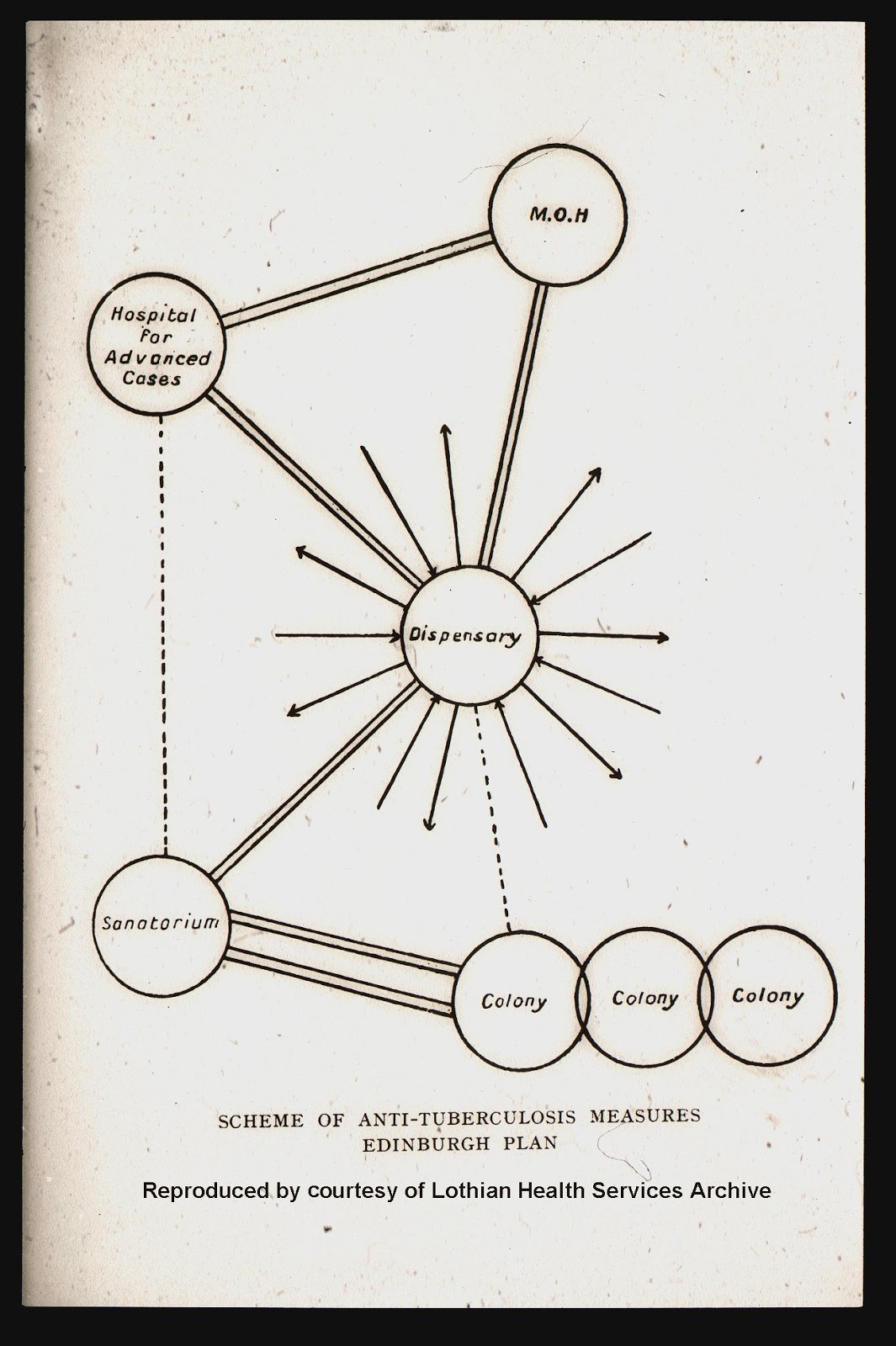
In Edinburgh in the late 1880s celebrated physician Sir Robert Philip pioneered a scheme, known as the Edinburgh Scheme, which took a three-strand approach to tackling tuberculosis through prevention, detection, and treatment. In 1887 he opened the Royal Victoria Dispensary in Bank Street, the first of its kind in the world. The dispensary became the cornerstone of the Edinburgh Scheme. Sufferers would report there for examination of their symptoms, when full details of their case history would be taken and patients would be instructed in how to avoid spreading the disease. The patient’s contacts would be identified and examined in order to catch the disease in its earlier, more treatable stages. Health visitors and medical officers would visit the patient’s home and check on living conditions, providing information on disinfection of the home.
A nurse from the Royal Victoria Dispensary visiting "an infected house". (LHSA Slide Collection)
 
Several other institutions provided treatment as part of the Edinburgh Scheme. Philip opened the Royal Victoria Hospital in Craigleith in the 1890s, with 76 beds. Patients could be sent there from the Dispensary for x-rays and treatment at the direction of the tuberculosis officer for Edinburgh. The Royal Victoria Hospital Trust also managed a voluntary institution at Southfield Sanatorium in Liberton, founded in 1914, which admitted patients with all forms of tuberculosis to its 96 beds. Scottish local authorities from outwith Edinburgh could send patients there for a standard fee if they lacked treatment facilities. Patients could also be admitted on the agreement that they were responsible for their own fees, which they were charged according to their means. Polton Farm Colony provided work for recovering or cured patients in an environment which was suitable for their health. Together, these institutions could provide treatment for tuberculosis sufferers at all stages of the disease.
The success of the scheme, reflected in the declining mortality rates highlighted at the beginning of this piece, inspired the legislative drive towards the notification of tuberculosis throughout the UK. Local authorities were ‘notified’ of infectious persons in their area, in order that a Medical Officer could examine the patient and check that they were receiving the treatment to which they were legally entitled. In this way, Sir Robert Philip and the Royal Victoria Hospital can be seen to have influenced tuberculosis treatment throughout the UK in the early twentieth century.
The case notes which form the bulk of this project come from the Dispensary and Southfield Sanatorium. Not only do they show us the background, symptoms and treatment of patients, but they also provide an insight into how this influential scheme worked in practice.
 Sources:
Bhopal, R. & Last., J, ed., Public Health: Past, Present and Future (2004)
Jenkinson, J., Scotland’s Health, 1919-1950 (2002)
Dept of Health for Scotland, Scottish Hospital Survey: Report on the south-eastern region (1946)

Friday, 4 September 2015

Hurrah for ARA!

In this week’s blog we hear from Ruth, who was at the Archives and Records Association (ARA) annual conference in Dublin last week.


I may not have seen much of Dublin, having barely left the conference venue, but the packed programme certainly made up for it! Speakers from all over the world contributed to the overall theme of the conference, that of the moral and legal obligations of the archivist - an area of particular relevance to us at LHSA as custodians of health-related collections that are so often confidential. I was very interested to hear about the research use of mental health records in Ireland and see how the legislation and atmosphere there differs from that here in Scotland. There was also a couple of papers that really opened my eyes to the issues and complexities around large-scale digitisation projects – not just what could or should be put online, but also the extensive work that’s required to prepare the physical collections for the digitisation process itself.
I was also presenting at the conference as I had a paper accepted on our internship programme for newly-qualified archivists and conservators. I described what we offer and why, and discussed some of the pros and cons of the programme. My aim was to focus on practicalities as much as possible so that if anyone attending was thinking about doing something similar they could see exactly how we manage the programme and how it might work in their own organisation.
And I was in good company, Head of Special Collections, Joe, was also at the conference as was Paul, our Skills for the Future trainee (who blogged about his time with LHSA last week). Paul was there with his fellow trainees and promoted both the Centre for Research Collections and LHSA in the information marketplace, in particular highlighting our case note cataloguing projects and discussing our recent cataloguing and conservation work for our HIV/AIDS collections.
Paul in the information marketplace
All in all, a successful conference – well organised, informative and with plenty of opportunities to make useful contacts, as well as offering us the chance to highlight our work to colleagues across our sector. If you’d like more info about the conference, there are abstracts of a number of talks and lots of photos on the ARA website at: http://www.archives.org.uk/ara-in-action/the-ara-conference.html?showall=&limitstart=.


Friday, 28 August 2015

From student to aspiring archivist: part 2


In my first blog for LHSA I talked about the journey from my time there as a student to my current role as a trainee. In this follow-up piece I will cover some of the exciting opportunities and valuable experience which my time here has provided me with.

Firstly, I would like to thank the LHSA team for having made me feel so welcome during the time which I have spent here so far. From allowing me to take part in the weekly team meetings to involving me in the renewal accreditation process (of which I will speak a little more of later in this blog) I truly have felt like an equal member of the team from the outset. Something which I feel that the CRC as a whole excels at and I know that everyone I have spoken to who has worked there, both past and present, feels the same.

Secondly, I would like to apologise in advance if this blog seems a little dryer than the last. The reason for my literate paranoia is that one of my duties as a Skills for the Future trainee is to keep a monthly learning log listing what I have been doing, experience gained and how I will put this into practice. It sometimes feels like I am making a hand-list of my own activities, which indeed I am, I guess, for future reference an ease of access. However, I promise to try my hardest not to fall into log mode and put you into sleep mode!

One of my main duties at LHSA has been working on the Norman Dott project cataloguing his case notes. I won’t go into great detail here about his ground breaking neurological work in Scotland and other elements of his distinguished career as this has been covered in other blogs. For me, however, it has given me the opportunity to work with LHSA’s unique methodology of cataloguing case notes using Encoded Archival Description (EAD), made me more experienced in writing XML and helped me to understand of the issues and precautions which must be considered when cataloguing more sensitive archives. Another benefit of this has been the massive boost to my medical knowledge and vocabulary as well as discovering some rather unusual conditions such as clawfoot and Paget’s disease (the former I had the pleasure of googling just before lunch). Some of the human stories to be found within the collection are fascinating and at times deeply moving: even when trying to remain objective and professional it would take a heart of stone not to be touched by them. There have also been some rather “out-there” cases, such as the travelling businessman who suffered from sore feet the moment he arrived back in Edinburgh yet was effected by this in no other place which he visited – one wonders if there was another reason behind this, of which I will say no more! Overall, I feel highly privileged to have played a small role in this project and I feel that it will make a great addition to my CV.


Patient with an Edinburgh allergy! (LHB1 CC/22/PR4.40)

I have also had the good fortune to receive conservation training for half a day each week with the very talented Emily Hick, whose work on LHSA's HIV/AIDS collections has been a real eye-opener for me in terms of developing new ways of housing and preserving non-traditional archival materials - from condoms to watches. My duties have been a bit less creative, but have introduced me to the fundamentals of surface cleaning and rehousing materials in preparation for long term preservation within the archive. I have also removed more staples in the last two months than I have in my entire life – and the strange thing is that I find this very therapeutic!
 
 
The CRC conservation studio
Lastly, as mentioned above, I have been trusted enough to be involved in LHSA’s accreditation renewal process for which I feel truly honoured. Not only has this introduced me to the Archive Service Accreditation Standard and its benefits, it has also allowed me to develop my knowledge of how an archive is managed from the top to the bottom, from the store to the search-room and everything in-between. I have enjoyed being a part of this so much that I have asked to continue working on it even after my time at LHSA comes to an end. So to wrap up I would like to thank Ruth, who had the idea to include me after I showed an interest in the accreditation process, and Louise for all her help and advice.

Friday, 21 August 2015

Frozen Storage for X-rays


In my last blog, I wrote about the deterioration of X-rays in the LHSA collections. This week, I will talk about how we intend to store them to slow down the rate of degradation.

The best way to store X-rays, and most photographic material, is to freeze them. Chemical reactions increase as the temperature rises, and colder conditions slow them down. So, by placing the X-rays in to temperatures lower than 0°C, the rate of deterioration will decrease.
 
A conventional freezer can be used to freeze small collections, but the items need to be properly packaged first to avoid any moisture coming into contact with film. We have decided to use a method recommended by the National Park Service, which uses two barrier layers to protect the photographic material. First the X-rays, which are already packed into inert plastic packages and labelled according to their reference number, will be placed into an archival box. Any empty space in the box will be filled with layers of conservation grade mount board and acid free tissue paper to help absorb any moisture inside the package.

X-rays sealed in inert plastic packages
The box will then be inserted into a tube of Marvelseal® (an aluminised polyethylene and nylon barrier film which resists the transmission of water vapour and other atmospheric gases), and sealed with a strong tape. A humidity indicator will be attached to the outside of this package, so that any moisture ingress can be easily spotted.

This package will then be inserted into a polythene bag which is again sealed with a strong tape. The box is then clearly labelled with its contents and placed into the freezer. A map of the contents in the freezer will also be made, so that the X-rays will be easy to find when needed.

If the X-rays need to be consulted at any point they can be removed from freezer, but will need to be slowly acclimatised to the warmer temperature, to avoid the formation of condensation on the film. To do this the X-rays can be placed into a study box and left in a stable environment overnight to gradually adjust to the new temperature.

This new storage method will increase the lifetime of the X-rays significantly. I hope you think of them next time you open the freezer door!

Have a look at the Media Storage Guide by the Image Permanence Institute for more information on the storage of photographic materials.

Friday, 14 August 2015

LHSA's Wellcome Trust funded collections


This week’s blog about our Wellcome Trust funded projects comes from Project Cataloguing Archivist, Clair.


As we welcome our new Project Cataloguing Archivist, Rebecca, to LHSA to start on our next Wellcome Trust (WT) funded project, in this week’s blog I wanted to reflect on all of LHSA’s collections that have benefited from the Wellcome Trust Research Resources awards thus far.  The Wellcome Trust offer support through these grants to repositories that hold significant primary source collections within the interdisciplinary field of medical humanities and social sciences. Naturally the rich variety of medical related records that we hold at LHSA can greatly benefit from these awards, which have enabled us to catalogue and preserve collections that hold huge research potential to the scholarly community and beyond.

Whilst working as Project Cataloguing Archivist I have been lucky enough to work on two of LHSA’s WT funded projects, including cataloguing Norman Dott’s neurosurgical case notes and cataloguing our UNESCO-awarded HIV/AIDS collections. Just last week I also got a taster for the project that Rebecca will be working on to catalogue LHSA’s TB and diseases of the chest cases notes and registers.

But before much of the cataloguing work could begin on projects such as these, conservation work was needed. Therefore, since 2002 LHSA has also utilised WT grants to conserve many of the collections that would previously have been inaccessible for major research due to their poor condition. Between 2002 and 2009, LHSA received five separate WT awards to preserve twentieth-century folder-based clinical case notes, including:

·       Case notes of University of Edinburgh clinical professors: Edwin Bramwell and Norman Dott.

·       Case notes of University of Edinburgh clinical professors: James Learmonth and Derrick Dunlop.

·       Case notes of the Royal Edinburgh Hospital.

·       Edinburgh's reproductive and sexual health case notes.

·      Edinburgh's case notes relating to tuberculosis and World War Two injuries.

From a cataloguing perspective it has not only been a luxury working with collections that have already gone through conservation treatment, but it is also integral to the output of cataloguing large collections. For example, case notes that have already been surface-cleaned and had staples and paper clips removed, as well as being re-housed in custom-made acid-free folders, means that the process of cataloguing at item level can be done at a faster rate – the quicker the output the quicker the collections can be used by our researchers.

Preserving these twentieth-century folder-based clinical case notes has enabled LHSA to open up scarce resources with unique insights into many medical specialisms and historically important medical pioneers. This project-based funding has also facilitated the development of methodologies and built on experience that has contributed towards quality catalogues and conservation techniques that can be shared widely. Over my time with LHSA, and within the University’s Centre for Research Collections, I have been struck by the transparency between various different projects and skill sets. There is a willingness to share information on best practice and adaptable methodologies, with advice being disseminated though publications and presentations.

Since 2011 LHSA has had three successful WT Research Resources applications - one complete and two on-going which will take us into 2017, including:


·        Policies, Postcards and Prophylactics: a project to catalogue and conserve LHSA’s UNESCO-awarded HIV/AIDS collections(1983-2010). Attached to this project WT funding also supported a one-day symposium entitled "Conserving Condoms: Modern Materials in Medical Archives" and a public engagement project with the creation of our online educational resource (link).


I am really enjoying contributing to the completion of our own projects. Working across such varied collections has been an exciting challenge but is also very rewarding. The training that I have received has particularly improved my cataloguing skills, which I will take forward in  future projects. I now have a deeper understanding of how an archivist can deal with voluminous, complex and sensitive materials in order to provide an intellectual way into the records, for the potential user base. Further opportunities and events have also been enabled me to connect with other WT funded projects across the UK. It is great to see how WT grants for medical humanities can be utilised through many different types of archive and library institutions. Some of my personal highlights have included:

·         Towards Dolly: Edinburgh, Roslin and the Birth of Modern Genetics, based at the University of Edinburgh (UoE). Attached to this project an exciting exhibition has opened at the UoE Main Library 'Towards Dolly: a century of animal genetics in Edinburgh' with a chance to see Dolly the sheep on display!

·       Care Not Confinement: cataloguing and preserving the Archives of the Crichton Royal Hospital, based at Dumfries and Galloway Archive Centre.

·        A Catalogue of Rare Syphilis Books, based at the University of Glasgow.

·        Cataloguing and Preservation of the HIV/AIDS Collections of the London School of Hygiene and Tropical Medicine.

Friday, 7 August 2015

RVH v TB

This week we welcome a new Project Cataloguing Archivist. Rebecca Nielsen introduces herself and the project...

I’m now at the end of my first week working on a new Wellcome Trust funded project, ‘RVH v TB’. On this project we’re setting out to catalogue LHSA’s holdings from the Royal Victoria Hospital’s tuberculosis and diseases of the chest case notes and registers. I’ll be working on this project for 18 months, alongside Clair, and between us we will be cataloguing over 17500 case notes for patients treated for tuberculosis or other chest diseases at the Royal Victoria Hospital. There are four series of case notes and an accession of administrative materials, using a similar methodology to the one used on the Dott project. The records are:

·         Royal Victoria TB Trust, Southfield Sanatorium case files: LHB41/CC1

·         Royal Victoria Dispensary for Diseases of the Chest case files: LHB41/CC2

·         Regional Hospital Board National X-Ray Campaign case files and volumes: LHB41/CC3 and CC3A

·         Royal Victoria Dispensary for Diseases of the Chest case files: LHB41/CC4

·         RVH Patient and Administrative Records: Acc 10/030

Diagram of the Edinburgh Scheme. (LHSA Slide Collection)

The Royal Victoria Hospital was a cornerstone of the Edinburgh Scheme, which I will describe in more detail in a future post, but essentially it was the first point of contact for people with tuberculosis to receive treatment and advice on preventing the spread of the disease to others throughout the first half of the twentieth century. These records also cover the period of mass X-ray screening in the 1950-1960s, which was an important way to identify and treat diseases of the chest. These records are a valuable source of information for researchers, covering several important developments in the history of treating tuberculosis in Edinburgh, and by cataloguing these case notes we will be able to support researchers who wish to study this area.

A fundraising appeal for the Royal Victoria Hospital Sanatorium. (LHSA Slide Collection)
I’ve only been here for a few days, but I’ve already managed to squeeze in a bit of time to take a quick look at the records, in between meeting my new colleagues and trying not to get lost in the corridors! I’ve come to the project with a slight advantage, as my last post was working on a project at the Royal London Hospital Archives called “The Fight Against Tuberculosis” (here’s the blog I wrote for that project). I’m therefore already familiar with the basic information needed before tackling a project like this, such as the history of treatment and the significance of particular details, as well as the terminology and abbreviations which can be so intimidating when approaching medical archives from a non-medical background. From what I’ve seen so far, the records provide a great insight into several aspects of tuberculosis treatment, and I’m looking forward to properly getting my teeth into cataloguing them.
Advice on preventing the spread of tuberculosis, from the Royal Victoria Hospital Tuberculosis Trust. (LHSA Slide Collection)