Friday, 3 November 2017

Interns out and about...

This week, LHSA interns Claire and Judith have had a couple of afternoons out, to visit Edinburgh University Anatomical Museum, housed within the Medical School Building on Teviot Place and the Royal College of Nursing Archive, on South Oswald Road.

On Tuesday afternoon, together with musical instrument interns Luca and Michela, we were fortunate to be given a behind the scenes tour of the Anatomical Museum, by curator Malcolm MacCallum. Home to an impressive collection of historical and anatomical specimens, the Museum was originally founded and developed by the Monro dynasty. The collection grew significantly in the late 19th and early 20th century, under Sir William Turner who was both Professor of Anatomy from 1867 to 1903 and Principal of the University from 1903 to 1917. Today, the Museum houses newer acquisitions alongside objects from the original Museum, with the whole collection comprising around 12,000 objects, illustrating the story of 300 years of Anatomy teaching at the University. More information on the history and collections of the museum can be found here, where you can also download an app for a virtual tour!


The entrance hall to the Anatomical Museum, image taken from the website above

This visit afforded a new perspective on the curatorial and conservation challenges of maintaining such a collection. In conversation with Malcolm, we were able to get an insight into some of the ethical challenges of caring for a collection which includes human remains. Human remains have a unique status within museum collections. They have the potential to make a contribution to the public good, through research, teaching and, when appropriate, display. However, because of their origin, there is a particular responsibility on the Museum to consider the way they are acquired, curated and displayed. Today, a number of interested parties may claim rights over some human remains. These include genealogical descendants, cultural communities and scientists. Institutions holding remains have to evaluate these potentially competing interests and acknowledge the complex legal and moral considerations. There is a need to deal sensitively with these issues and to draw a careful balance between the attitudes and beliefs of different groups. It was fascinating to be able to talk to Malcolm about these challenges.   

On Thursday afternoon we visited the Royal College of Nursing (RCN) Archive, which is based in Edinburgh. The Archive holds collections for the entire UK organisation and includes corporate records dating back to 1916, as well as a wealth of personal papers, oral histories, photographs and objects.

It was a pleasure to meet Fiona Bourne and Neasa Roughan, the Archivists at the RCN, and get an insight into what they do and see some of the treasures they hold. The RCN is run by members and the decisions taken at a governance level reflect what members have asked for. The corporate archive ensures that these decisions, along with all the work undertaken to implement them, is recorded and is an immensely important collection. Our favourite part of the archive though is definitely the personal archive, including the personal papers of individual nurses from 1822 to the present day and over 700 oral history interviews with nurses.

Personal archives are a wealth of information on day-to-day life. Corporate archives might show high level institutional history but personal stories, whether on paper or audio-tape, allow historians, researchers and curious individuals to really know what life was like for a nurse. These archives give us an insight into what their work involved, how they lived, what they did in their spare time, and what life was like in different hospitals and different wards across the country. For an organisation such as RCN, their personal archives can help them show how the work they do has affected the working lives of nurses over the last 100 years.

The RCN archive is a great example of how diverse collections can be, and how important each type of collection is. Without the corporate archive the RCN would lack accountability, and would have no reference to when or why past decisions had been made or actions taken, and without the personal collections the RCN would have less information on how their decisions or actions had affected the lives of the nurses they aim to support. We really enjoyed our visit to the RCN and are looking forward to learning even more about the history of nursing through the coming weeks with LHSA.


Friday, 27 October 2017

Rehousing carbon dust surgical drawings

Hello! I’m Judith and I’ve recently joined the LHSA team as a conservation intern. I’ve moved to Edinburgh for 8 weeks from Newcastle, where I recently completed a two-year MA in conservation of works of art on paper at Northumbria University. During my internship I will be working with a range of material from the archive, including photographic materials, architectural plans and bound volumes, as well as rehousing several collections. This is my first real foray into a large archive and the past two weeks have been an eye-opener!

In preparation for rehousing, together with Claire (LHSA archive intern) I have been surveying the collection of medical illustrations, demonstration boards, sketches and photographs generated through the practice of the great Edinburgh neurosurgeon, Professor Norman Dott (1897-1973). Dott emphasised the importance of good medical illustration and used professional medical artists to document his work and publications. Medical artists were held in high regard during this period; in more recently years this has largely been superseded by photography. Amongst the fascinating range of illustrations in the archive are 70 carbon dust drawings of clinical procedures. Having never come across drawings like these before I thought I would share some of what I have been discovering.

Pioneered in the early 1900s by Max Brödel (1870-1941), medical artist at the John Hopkins School of Medicine, Baltimore, carbon dust drawing was used to produce clinical images representing anatomical detail. The technique allows for a wide variation in tone, shading and highlights, to display a range of textures, making grey-scale, tonal illustrations look like living tissue.
Small board with three drawings of details of the brain. The carbon dust drawing is top left, demonstrating the tonal variations possible compared to the line drawings in pen below. Artist: B. Craig, 1939.  
In the early twentieth century the Philadelphia lithographer Charles J. Ross invented Ross Board, which was a board consisting of a paper or cardboard substrate with a thin layer of approximately 1/32 of an inch of finely ground white chalk (often gypsum) mixed with a binder. The chalk mixture was applied to the cardboard under pressure. To produce a drawing, typically an artist makes a preliminary drawing on paper using a carbon pencil, which is then reversed and traced onto a second sheet. This second sheet is placed face down on the board and the image outline transferred to the board by carefully rubbing along the lines using a flat tool or thumb nail. This ‘double transfer’ method leaves an outline image to which tone, shading and depth can be then added by brushing on thin layers of fine carbon powder. Layers of powder can be built up to produce detail or rubbed away to give highlights, and coloured details can be added in pencil or ink.

Carbon dust drawings showing surgical procedures. Artist unknown.
The technique began to make its way to Edinburgh when Audrey Arnott (1901–1974), an artist based at the London Hospital, visited Brödel in 1932. On returning to England, she passed on the new technique to colleague Margaret McLarty (1908–1996), a freelance artist who had originally trained under Professor Dott. Hester Thom, a Canadian artist and another of Brödel’s students, was Dott’s personal artist until 1939; she taught the technique to Clifford Shepley (1908–1980) who was appointed as medical artist at Edinburgh University in 1934. The drawings in the archive are by a number of different artists, including Thom and Shepley.

A carbon dust drawing showing a brain prior to impact with a wall, with coloured highlights. Artist: Clifford Shepley, 1960. 
Over the coming weeks I will be rehousing these, to better protect the delicate surfaces of the drawings and make them more easily accessible. The drawings are currently stored in folders in plan chest drawers, one on top of the other. This has allowed movement within the drawers as works were removed for production to readers, leading to some abrasion to the surfaces and loss of gypsum at the corners and edges.
A carbon dust drawing of a brain from above. One of the main conservation risks to the drawings is mechanical damage to the fragile, smooth surface of the gypsum, which is susceptible to scuffing, burnishing, cracks and losses. In this case, the missing corner of the black supporting board has resulted in cracks developing from the bottom left corner. Artist: Ann Brown, 1956. 
If you’d like to know more about these unique drawings or the progress of the project, do get in touch!

Friday, 13 October 2017

Hello to new intern, Claire!

As part of a commitment to offer valuable experience to very recent archive and conservation graduates, LHSA has been offering a number of short-term, paid internships for a while now. We've seen our interns go on to bigger things over the years (often coming back to work for us in professional posts!), so it's great that we've been able to offer two internships again this year, one centred on archive cataloguing and another in conservation. This week, we hear from Claire Boyle, who's joined the team as our 2017 archive intern:

Hello! I’m Claire and I’m the new archive intern working with the Lothian Health Services Archive (LHSA). I’ve volunteered with the Centre for Research Collections before, working on the Towards Dolly project, but this is my first foray into the medical collections that LHSA hold and I’m really excited to get started.

For the past year I’ve been completing an archive traineeship in the Historical Search Room of the National Records of Scotland (NRS), which has given me a great grounding in the customer-facing side of archives; and I am also well-versed in the ways of family history research. I graduated in June from the University of Dundee with a Postgraduate Diploma in Archives and Records Management, and, when I finished my traineeship at NRS in September, I decided that I needed to round off my archival training with some cataloguing experience. The LHSA cataloguing internship came up and I was lucky enough to be selected to work on LHSA’s photographic collection for a period of eight weeks. With my first week drawing to a close, and some initial scoping work done, I thought it would be useful to look ahead at what I’ll be doing while I’m here. LHSA’s photographic collection is made up of around 40,000 images and includes, not just photographs, but films, glass plate negatives, slides and digital photographs. My work on the collection will focus mainly on photographic prints and their associated negatives, and slides. 

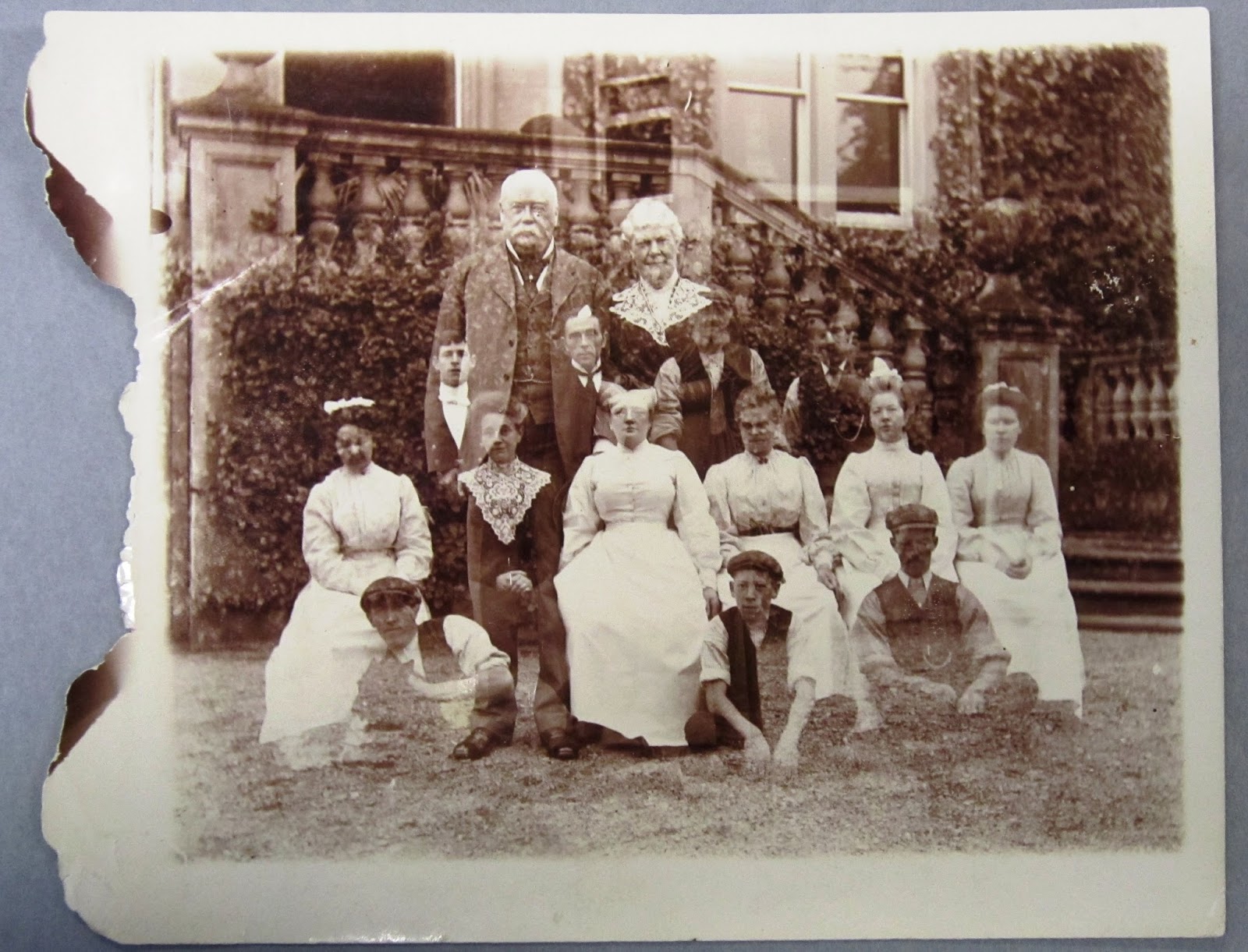
An example of the type of photograph I will be working with. This is a double exposed image of a group photo of staff at Pinkieburn House, and a portrait of Aunt Hannah and Uncle Willie, c.1885 to 1910. Pinkieburn House, originally a family home, was gifted as Edenhall Hospital in 1917 and became a hostel for limbless ex-servicemen from 1918. By 1920 it was also a convalescent home and during WWII it then became the main Ministry of Pensions Hospital in Scotland providing general medical and surgical treatment for war pensioners. This image shows the staff and members of family of Pinkieburn House while it was still occupied as a family home. (Staff at Pinkieburn Uncle Willie & Aunt Hannah superimposed, PH36/58) 


It will be my job over the coming weeks to work with a selection of LHSA photographic material, some of which is uncatalogued and some of which is catalogued in a legacy cataloguing system and needs updating (like the photograph above). I’ll hopefully be establishing what is held, cataloguing the material using the current cataloguing system and rehousing the material into archive-friendly sleeves and boxes. I will also be undertaking a myriad of tasks that I’ve yet to find out about, but that I’m sure will be equally fascinating given the rich history that LHSA holds. In completing this work, I will be helping LHSA make its photographic collections more accessible to researchers (students, academics and the public alike) and increasing my skill-set to help me develop my career within the record-keeping sector.

Over the next seven weeks I will be helping to contribute to LHSA’s social media, so no doubt you will hear from me again and I can update you on how I’m getting on, and what interesting things I’ve discovered. Until then, you can find out a little more about the archive and our collections on our website, and if you want to see more of what we get up to in the office, take a look at some of our previous blogs. 
Claire working in the office

Friday, 29 September 2017

Scrap metal?


This week’s blog is from our newest volunteer, Danai.

My name is Danai and I am a conservation technician from Greece. I have lived in the UK for the past five years, and this is my first time volunteering here. I moved to Edinburgh because I want to learn more about the history and heritage of Scotland, and I now volunteer in the Conservation Studio at the Centre for Research Collections, University of Edinburgh, treating heath archive material in particular. 


In the past, I have worked with, and conserved, many different materials and objects, and have also spent time as an exhibition assistant, where my main responsibilities were the correct packing and storage of items. I hope to extend my experience through volunteering at the University, and to meet new people. 


My volunteer role is to treat and rehouse loose sheet material and I have been removing metal fasteners (see the picture below of all the fasteners that have been removed so that they don’t damage the paper), unfolding creases, surface cleaning, placing papers in new, labelled, folders and then putting those folders in boxes. 


I have already learnt a lot about how to care for archive material. This is very important to me as it is a completely new field, and with the help of conservation and archive staff here I am extending my knowledge to the next level. Once my current work is complete I am hoping to move on to new projects and learn more.         

Friday, 22 September 2017

Something a little different for a Friday afternoon…

This Friday’s blog comes to you from Ruth, the LHSA Manager.

I originally trained as a fine art conservator, and as a manager of an archive I draw on that training when we repair individual items as well as when providing wider collections care for all the material in LHSA. The foundation for making sure that collections care is appropriate and to the highest standard possible is in knowing what you have in your collections, what those collections are made of and, therefore, what they may be particularly vulnerable to so you can work to ensure their stability for the future.

A couple of Fridays ago we had a demonstration of a piece of equipment that can help us understand what an object is made of by identifying the elements in it: a portable x-ray diffraction spectrometer…

We got a brief introduction into the science behind the equipment – x-rays displace inner shell electrons in the object you are analysing and that displacement is measured to identify the element(s) present. Once you know what elements are there you can start to work out what the object is made of. And we got some practical demonstrations of this….

We started on something slightly less significant – an office mousemat! – and from there we moved on to some real collection items to see how we might use the equipment in practice. Scans of a bound volume with metal decoration showed that the metal was brass and therefore not likely to be a more modern addition, and scans of a flute showed that though it had been described as crystal when it had been originally manufactured and sold, there was no lead present, so we’ll have to describe it as a glass flute from here on!


We do a lot of materials identification during the course of our work with rare and unique collections, and it was really interesting to see the options that such a sophisticated piece of equipment like this can offer.

Friday, 15 September 2017

Reading by Moon's type...

This week, Louise has been finding out about just how much reading can mean to those with sight loss, and how systems of reading for the blind are reflected in our archive...

A couple of weeks ago, we were lucky enough to receive an invitation from our friends at the Royal National Institute for the Blind (RNIB) Scotland to attend an event at the Edinburgh International Book Festival with author Graeme Macrae Burnet. The event was a recording of a special edition of Connect Radio, RNIB's online radio station, based around talking books. We've worked with RNIB Scotland before as well as holding their archive. We've participated in their Seeing Our History project by indexing Edinburgh's Register of the Outdoor Blind from the beginning of the twentieth century, and also hosted researchers around the project.

RNIB is dedicated to opening up books to people with sight loss, by providing braille and giant print editions or talking books that can be accessed by digital download or through a USB drive or CD. Titles are available free to borrow from RNIB's online library. The event started with an interview with Graeme Macrae Burnet hosted by Connect Radio presenter Robert Kirkwood. You can borrow both of Burnet's current books from the RNIB library - the first, The Disappearance of Adele Bedeau and his latest, His Bloody Project. His Bloody Project made the Man Booker Prize shortlist last year, and as such was available in accessible versions. RNIB work in partnership with prize organisers every year to make sure that the six shortlisted novels are available to those with sight loss in talking book, braille and giant print versions. His Bloody Project is based around (fictional!) 'found documents' from the archives, and the very real career of police psychiatrist and criminology pioneer James Bruce Thomson, so that immediately peaked my interest...

The interview was then followed by a panel discussion about how much having access to reading through RNIB has meant to individuals, both those born without sight, and those having to deal with progressive blindness. It brought home how reading in whatever form has the ability to lift people feeling isolated and alone, especially those coping with deteriorating vision. Reading can be a form of imaginative escapism and widening horizons, and blindness can limit access to those experiences, not to mention the possibility of being unable to participate in the way that books weave themselves into daily life and culture.

Attending the Book Festival event made me think of much earlier evidence about promoting access to reading reflected in the RNIB archive. The earliest example that we have is Moon's Type. William Moon (1818-1894) invented a simplified system of raised type (the Braille system of dots is also raised type, more familiar to us now).

William Moon, 1873 (GD52/3/1)
 Moon had lost the sight in one eye at aged four. After leaving school his sight deteriorated until he was completely blind by aged 21, scuppering his ambitions to become a missionary. Following many failed experiments dating back to as early as the sixteenth century, raised type as a system of reading for the blind started to gain ground in late eighteenth century France. Moon himself mastered reading in raised type, but was distressed to find that some people could not. There would have been a couple of different versions at the time, including Lucas's Alphabet and Alston's Alphabet. Moon instead invented a simplified form of raised type alphabet, using fourteen different shapes at different angles. 

Dr Moon's Alphabet for the Blind, c. 1850s (GD52/1/1/1)
At first, Moon printed texts himself. From the beginning, the invention of the type was tied into Moon's evangelical Christian faith - he wanted to bring scripture to those whose lack of sight meant that they couldn't read the Bible in conventional ways. Moon's Alphabet was also adaptable to many different languages (particularly helpful to the travelling evangelical mission community), as shown below.

Moon's Alphabet in different languages (GD52/3/3)
Moon not only traveled around the UK, but also in Europe and as far afield as Australia  to promote his system of reading. One list of Moon's texts in English and other languages from his own lifetime was made up solely of scripture, texts on scripture or raised maps:

A map in Moon's System (GD52/3/1)
Another more extensive catalogue does feature memoirs (of religious figures and royalty) and poetry, although'poetry' is mainly made up of hymns! However, there were also teaching materials for children in Moon's Alphabet:

Geometry taught using Moon's Alphabet (GD52/3/3)
Helped by donations from wealthy patron Charles Lowther, Moon's system spread, and was received extremely favourably compared to previous, more complicated alphabets. Moon also drove the rise of the Home Teaching Society initiative, where blind people would be encouraged to read in their own homes, spreading Moon's Alphabet to those outside the Blind Asylums (institutions to provide work and lodging to blind people). Edinburgh had a Home Teaching Society (founded in 1856), the Edinburgh Society for Promoting Reading Amongst the Blind at their Own Homes on Moon's System, reflected in the earliest reports we have in the RNIB collection.


Early reports from the Edinburgh Society (GD52/1/1/1) 

Perhaps unsurprisingly for a document that was meant to fuel charitable donations, the reports we have from the Edinburgh Society are full of praise for Moon's system. A bit more unusually, though, they cite experiences from partially sighted people themselves (albeit mediated through the testimonies of their tutors). This is one case study from the 1858 report:

"Mr. ------ has been blind for eight years. A few months ago a friend sent him Moon's Alphabet, but having no one to explain it, he could at first make nothing of it. A few weeks afterwards, however, meeting a blind member of the congregation with whom he is connected, he mentioned the circumstance. His friend happened to be a reader by Moon's system, and in one lesson had the pleasure of remving all his difficultues. Mr. ---- can now read with ease and comfort." (1858)

The 1860 report featured a direct statements from the male inmates of Edinburgh's Blind Asylum:

"The character is simple, easily felt and easily remembered. We are warranted in stating that individuals of any age can easily acquire a knowledge of it with the least possible trouble."

The sheer variety of texts, formats and ways to consume reading (without being treated as an object of pity or potential vessel for conversion) offered by RNIB shows just how far reading for partially sighted people has come since the earliest examples we hold. If you're interested in helping more people with sight loss to access the lifeline of reading, you can learn how to sponsor a talking book here.


Friday, 1 September 2017

Nights on the ward - the Night Superintendent's Report

This week, Alice has been looking at a little-used but fascinating set of records that shed light on the daily workings of the Royal Infirmary of Edinburgh

In order to reform nursing and nurses training at the Royal Infirmary of Edinburgh (RIE), in the 1870s trained ‘Nightingale Nurses’ were recruited and a training program instituted. Under this new system, the nurses reported to the Lady Superintendent of Nurses, rather than individual ward doctors. In addition to the Lady Superintendent there was the Night Superintendent, who monitored staff and patients throughout the night.

As there was little cross-over in their hours, the two used small bound notebooks as a means of communication between night shift and day shift. The left-hand pages of each book contains instructions recorded by the Lady Superintendent at the end of her day; and on the corresponding page the Night Superintendent would record the happenings of the night).

These little volumes are a fascinating way to supplement some of the other records we hold. Some pages contain snippets about staff which paint a vivid picture of the differing personalities of nurses, such as this entry:

27th-28th March 1876
“I made 3 rounds, nurses all in their places but Louise of 4 M[edical] I found her twice in one hour absent from her ward. She was with the night nurse in 5 M[edical] each time. I told her I would report it to you…
Nurse McLeod was not well at 5am but thought she could do her work so I let her” - (LHB1/103/7)

LHB1/126/50 - Christopher's entry in the General Register of Patients
Others add life to the lists of patient names that are recorded in the General Registers. For example, where in the register 8 year-old Christopher Yeoman appears as one name amongst many, this small detail from the Night Superintendent’s report paints a picture:

30th – 31st March 1876
Lady Superintendent: “The mother of the child in 3 S[urgical] is staying with him tonight so Nurse Black is not there”.
Night Superintendent: “The boy has had a quiet night; he is always much better with his mother”.

 The job of nurse was a risky one; often, the Superintendents’ notes to each other either request or provide details about unwell colleagues. There are numerable instances of nurses falling ill, and and Mary Anne Barclay is one such nurse.
LHB1/97/1 - Nurse Fraser's training record shows the perils of the job
Mary Barclay entered the RIE as a probationer on 19th January 1876 having previously been employed for a time at Chalmers Hospital in Banff. According to her training record, she spent three months working in the Infirmary’s medical wards before she fell ill.

LHB1/97/1 - Nurse Barclay's training record
The first mention of Nurse Barclay’s illness in the Night Superintendent’s reports comes at the start of April 1876. As part of her general instructions for the night of the 6th April, the Lady Superintendent requested that the Night Superintendent “please visit Nurse Barclay [in] 1 lower dormitory”. The return reply records that “Nurse Barclay has not had a bad night – Nurses Brown and McLeod each gave her a fermentation”. The following days’ correspondence suggests continuing concern for her well-being:

7th - 8th April 1876
                Lady Superintendent: “Nurse McDonald will stay on duty with Nurse Barclay til Dr McLeod has seen her.”
Night Superintendent: “Nurse Barclay had some sleep but had pain when awake so I told Nurse McDonald to stay with her.”

The next night shows a further downturn as Nurse Barclay was admitted into the hospital as a patient:

8th - 9th April 1876
Lady Superintendent: “Nurse Barclay was warded in 14 M[edical]. Will you report of her in the morning.”
Night Superintendent: “Nurse Barclay has been quiet but has not slept much : she looks very bad.”

Her recovery was slow but ultimately successful, with her training record noting that she was “about ten weeks absent” before continuing her training with “nine months in surgical wards”. Ultimately, her hard work and commitment to the vocation paid off. She was described as “patient, obedient and industrious, of slow intelligence but very painstaking, high principled and kind”, and after two years working on the night staff of the RIE she left to take up the post of Matron of Wallasey Cottage Hospital in Birkenhead.

The Superintendents were also there to offer guidance and mentor the novice nurses and support them in carrying out an often difficult vocation, as can be seen from these snippets:

                19th – 20thth April 1876
Lady Superintendent: “Bad case in 3 M[edical]. The nurse there is timid, please assist as often as you can”
Night Superintendent: “3 M[edical] - The poor old man died at 3.40am”

                1st – 2nd May 1876
Lady Superintendent: “Nurse Collins being off duty, Nurse Munro is in 16 S[urgical]. Nurse Macrae is also off duty, and Nurse Wyllie is on 4 M[edical]. Both these are young nurse and will need some looking up, especially as there is a sharp typhoid case in 4 M[edical]”

                8th – 9th May 1876
                “7 M[edical] - Nurse Small is taking charge of the tracheotomy case and Nurse Callow to do the rest of the work. The latter being new to us, give good heed to this ward.”

Although intended as administrative records, these volumes are a wonderful way to experience more of life on the ward, and the nurses’ concern for their patients really comes through.