Thursday, 30 January 2025

Conservation (1): What is conservation?

In this new series, we will explore the importance of conservation work for LHSA collections. From the very basics of what 'conservation' entails in an archival context to examining some significant case studies from recent years, we will show you some of the work that takes place behind the scenes and that is essential to grant access to collection items.


What is Conservation?

Conservation aims to stabilise the condition of, and limit any further damage and deterioration to, a given object whilst working ethically to provide the best treatment possible. It can be broadly divided into two interrelated categories. Interventive conservation involves treatment to address the chemical and physical effects of damage and deterioration, cleaning and tear repair, whereas preventive conservation includes the provision of proper storage and monitoring and control of the environment. Conservation seeks to ensure long-term preservation and, in the case of LHSA, to enable continued safe access to a historically, socially and medically important collection.


LHSA's Preservation and Conservation Programme

LHSA aims to undertake collection-wide preventive conservation strategies, coupled with interventive conservation treatment of individual items or series as necessary in order to address the preservation and conservation needs of the collections. Core work funded from the annual budget is coupled with externally-funded projects and the programme is formalised in the LHSA Preservation and Conservation PolicyPlease contact us if you'd like to consult the full policy, or for any further information.

LHSA has played a key role in developing the University of Edinburgh's Disaster Response and Recovery Plan for its rare/unique collections. The Plan covers LHSA material and ensures that we offer best-practice collection care. An edited version of the Plan (with all sensitive data redacted) is available here.


Pile of paperclips.


Core Conservation

LHSA has spent years establishing a conservation profile and now has an active programme of preservation and conservation work funded by the annual budget. This ranges from surveys to determine the condition of all or parts of the collections to preventive conservation measures to stabilise and, where possible, improve the climate in which the collections are housed; for example, environmental monitoring and re-housing. Interventive treatment of individual items is also undertaken as necessary. For example, conserving bound volumes and architectural plans. Supplementary work includes photographic and written documentation, writing applications for external funding, and disseminating the results of LHSA's core and project work via presentations, publications, workshops and tours.

Access to the collections is also supported through the preservation and conservation programme. Examples include the provision of guidelines and training on handling, the production of surrogates or substitutes as necessary, and the preparation and installation of exhibitions.


Surface cleaning using an eraser and a natural hair brush.


Core conservation work may be undertaken in-house or contracted-out to specialist commercial companies depending on the material nature and quantity of items to be treated, the treatment required and the availability of funds from the annual budget.


Conservation Projects

LHSA is committed to generating project funding to supplement core conservation work. In recent years, grants have been secured from the Wellcome Trust, the National Archives of Scotland, and the National Manuscripts Conservation Trust. Awards have ranged from £649 to part-fund the conservation of four handmade Clennell booklets and £1,100 to treat indexes to the Royal Infirmary of Edinburgh general register of patients to £120,000 to preserve twentieth-century folder-based medical case notes. Work may also be undertaken by project staff specially recruited or contracted-out to specialist commercial companies as appropriate.


Royal Infirmary of Edinburgh Indexes to the General Registers before treatment.


All core preservation and conservation work as well as projects are governed by the LHSA Preservation and Conservation Policy and adhere to professional standards and best practice for both treatment and documentation.

LHSA gratefully acknowledges the support it has received from external funders.

Monday, 27 January 2025

Spotlight On… (2): Bruntsfield Hospital

Bruntsfield Hospital had its origins in the Edinburgh Provident Dispensary for Women and Children. It was founded by Sophia Jex-Blake at 73 Grove Street in September 1878 to provide medical care for women in an environment staffed solely by female doctors and nurses. A successful campaign in the 1950s ensured that this ethos was upheld despite the Department of Health for Scotland's wish to appoint male doctors.


 73 Grove Street Dispensary (LHB8/17/1(ii).

When the Dispensary moved to 6 Grove Street in 1885, it was able to provide six beds for women requiring hospital treatment, and the institution changed its name to the Edinburgh Hospital and Dispensary for Women and Children. In 1899, when Sophia Jex-Blake retired and left Edinburgh, the hospital's Executive Committee acquired her home, Bruntsfield Lodge.

After alterations, the lodge provided 18 beds as a small general hospital for women: it gradually expanded and its bed complement reached 72. In 1910, after a number of years of cooperation between the staff of the two institutions, Bruntsfield Hospital amalgamated with Elsie Inglis' Hospice in the High Street. Medical, surgical and gynaecological work was done at Bruntsfield, while obstetric and infant work was carried out at the Hospice. Like the Hospice, Bruntsfield Hospital retained its own dispensary and its own name.


Bruntsfield Hospital (LHB7/17/1(x).

Both Bruntsfield Hospital and the Elsie Inglis Memorial Maternity Hospital were closely connected with Edinburgh's best known medical women. They originated from the wishes of Sophia Jex-Blake and Elsie Inglis to provide medical care for women, while at the same time offering practical experience to young female doctors. Jex-Blake (1840-1912) was one of the first female medical students at Edinburgh University and campaigned for women to be allowed to train in hospitals, successfully obtaining the right for them to receive clinical training at Leith Hospital in 1886. In setting up Bruntsfield Hospital, she was able to ensure medical training for female doctors whilst at the same time providing much needed hospital care for women.


Portrait of Sophia Jex-Blake (LHB8/17/1(i)).


Bruntsfield Hospital amalgamated with the Elsie Inglis Hospital in 1910. From 1948, the Bruntsfield became part of Edinburgh Southern Hospitals group under South Eastern Regional Hospital Board. The hospital remained open until 1989.

Monday, 20 January 2025

Tales from the Archive (1): The story of the ‘Sick Kids’ Hospital

“the mortality which takes place among children, and in particular among the children of the poorer classes, calls for an immediate effort to alleviate so much suffering and avert so great a loss of life; and that for this purpose it is necessary that a suitable hospital be provided in some salubrious locality in or near Edinburgh.”

The Royal Edinburgh Hospital for Sick Children is celebrating its 165th anniversary this year. The mission of the hospital fulfilled the wishes of its founders, who were moved by the plight of sick children in mid-nineteenth century Edinburgh. The above statement of intent appears in the minutes of the Promoters for a Hospital for Sick Children in April 1859. The group formed in response to a series of letters published in the Scotsman in early 1859, which called for the establishment of a hospital where children could be treated separately from adults. Like the Royal Infirmary of Edinburgh, it was to be a voluntary hospital, financed through philanthropy and by attracting subscriptions from private donors and organisations. The promoters set about securing funding for the hospital, appointing staff and finding suitable premises. By the end of 1859, a house at 7 Lauriston Lane had been leased and was furnished with eight iron beds measuring five feet long by three feet, two inches wide, and four measuring four feet long by two feet, three inches wide. The first patient, Mary Sutherland aged 1 ¼ years was admitted on 15th February 1860 suffering from dentition of bronchitis (bronchitis brought on by teething). She was discharged and recovered on 18th October.


Extract from Register of In-patients showing Mary Sutherland's admission (LHB5/5/1).


Meadowside House

It quickly became apparent that the Lauriston Lane building could not accommodate the numbers of children requiring treatment and, in 1861, the Contributors drew up plans to acquire larger premises which would include more beds and a separate fever ward. They instituted a building fund for which all sorts of fundraising initiatives were created; the Ladies’ Committee held a bazaar over five nights which added £1,300 to the appeal and Dinah Craik, the “accomplished authoress of John Halifax, Gentleman” lent her support which drew in many donations. As a result, Meadowside House was purchased and refurbished for the sum of £5,500. It opened in 1863 and, granted royal patronage by Queen Victoria, became the Royal Edinburgh Hospital for Sick Children (REHSC). It had 40 beds and the separate fever ward that had been hoped for. A further 30 beds were added with the addition of a new wing in 1870.


Royal Edinburgh for Hospital for Sick Children, Sciennes Road, c. 1950 (P/PL5/004).


Ward at Plewlands House, c. 1890 (P/PL5/001).


Plewlands House & Sciennes Road

As the demand continued to grow, and an outbreak of typhoid fever within the hospital affected several members of staff and caused the death of a nurse, new premises were once again sought. The Directors decided to move the hospital to other premises while Meadowside House was thoroughly examined. They managed to secure the lease of Morningside College at Plewlands, where all the patients were moved to in 1890 whilst a new, permanent site could be found.

By the 1890s, the hospital had a large network of contributors throughout Scotland and received subscriptions in the region of £7,000 to £8,000 each year. Companies, churches, and individuals all gave money whilst charity events such as dances and concerts continued to be held for the cause. In 1895, the former hospital premises at Sciennes Road were purpose built at a cost of nearly £50,000 and opened by Princess Beatrice.


Achievements

Dr Joseph Bell, on whom Sherlock Holmes was modelled, was the first surgeon to be appointed at the hospital in 1887 and remained there until he retired. He provided a new dimension to the hospital where previously there had been no surgical department. By 1892, the surgical wards were full of children injured in cart and tram accidents, but the largest number were treated as the result of joint disease, especially of the spine and hip.

The REHSC established a Department of Medical Electricity in 1897, only two years after the discovery of X-rays. In 1913, the Department for the Diseases of Ear, Nose and Throat in Childhood was opened, the only such ward in Britain at that time. Throughout its history it has had strong ties with the University of Edinburgh, working to develop the field of paediatrics and training students in this discipline. After the arrival of the NHS, the hospital continued to innovate: a new Ear, Nose and Throat operating theatre was built, the Department of Psychological Medicine was established and advances were seen in anaesthesia, transfusion and burns treatment. These innovations continued: in the 2000s, it installed a hi-tech baby pod (the first of its kind in Scotland) and was the first in Europe to fit a hi-tech operating system that allows more keyhole surgery.


The Future

The hospital moved from Sciennes to a new building at Little France, next to the Royal Infirmary of Edinburgh, in July 2020, with all services transferred there by March 2021. On 5th July 2023, HRH The Princess Royal officially opened the RHCYP. There, it benefits from the most up-to-date technology, and the proximity of world-class facilities at the Royal Infirmary. After 165 years, the vision of the founders continues to flourish: a hospital providing the best care for the city’s sick children, and those from further afield.


LHSA Sources on the Royal Edinburgh Hospital for Sick Children

The following collections are recommended for research into the REHSC using LHSA material:

Royal Edinburgh Hospital for Sick Children 


Monday, 13 January 2025

Spotlight On… (1): Stories from the Craigleith Hospital Chronicle


The Craigleith Hospital Chronicle is a rich resource of articles, poetry, drawings and photographs reflecting the aspirations of those who fought in the First World War. It contains stories on a wide variety of topics and rarely misses an opportunity to add propaganda value.

LHSA has a collection of 13 issues of this military magazine, unfortunately not a complete run. It was produced by the Second Scottish General Hospital, Craigleith during the years of the Great War. Staff and patients submitted articles, stories and poems on many different topics. Many provide a valuable insight into life as a soldier, patient or member of hospital staff at this time.

The Craigleith Hospital Chronicle, Volume One, No.2 (LHSA Ref: GD1/82/1) is the first in LHSA's collection, articles include: "Duties of a Ward Orderly", "An Impression of the Belgian Wounded" [arriving at the hospital in October 1914], "Christmas Day in Hospital"; and a poem entitled "A Private's Alphabet", the first lines of which are repeated below:

"A is the Army, to which we belong;

B is the Battle, we wage against wrong.

C is the Cause we are all fighting for;

D are the Devils who started this war..."


 ‘Craigleith Hospital Chronicle’ magazine (GD1/82).


Craigleith Poorhouse was founded in 1868 and served the St Cuthbert's district of Edinburgh. It included an Infirmary for the care of sick paupers. In 1914, the Poorhouse was taken over as a military hospital and renamed the Second Scottish General Hospital, Craigleith. The Poorhouse returned to its former function in 1919, and in 1929 it became the Western General Hospital.

An article in volume 1 number 5 from April 1915, ‘Lighthouses in War Time’, describes the war from the point of view of lighthouse keepers and sailors. It explains that in autumn 1914 the command was given, ‘lights out on the east coast’. This may have baffled enemy movements by night but it also added anxiety, delay and danger to allied merchant ships’ sailings.

According to the article, some mail boats had changed their sailing times to complete voyages during daylight. Also included is a story in which the crew of an Orkney vessel found they were being tailed by a German submarine. The captain of the ship decided that the submarine meant no harm but was merely following them to gain a safe passage through the Pentland Firth. The article then claims that the ‘wily Orkneyman…led his unwelcome follower a wild dance across the shoals and shallows’ until the submarine ran aground!

Moving onto the work of the lighthouse men, the article states that although the lights are not lit, the machinery is continually oiled, cleaned and ready for use. Therefore, their work is constant and essential. It informs the reader that ‘with the least encouragement’ many of ‘these brave fellows would gladly don khaki’, but the best way they can serve king and country is to persevere with their present work.


‘Craigleith Hospital Chronicle’, Volume One, Number Five, April 1915 (GD1/82/3).


An interesting feature of the writing style is how it describes lighthouse keepers and sailors as masters of their craft. Adjectives such as patient, painstaking, steady, reliable and nimble paint the character of men who do their job very well, while the phrase ‘handy with a boat’ and ‘as clever with their hands as jolly tars’ emphasises how skilful they need to be. It also mentions their ‘cheery philosophy’, showing that despite their isolation they remain steadfast. By creating a sense that all people in Britain and its allied countries, no matter what they were doing, were diligently working towards a common cause, the hospital magazines would have attempted to build up the morale of soldiers who may have had to spend months recovering and inactive.

The publication is an invaluable account that delves into the personal experiences of those involved in such a convoluted event.

Monday, 6 January 2025

Disability Employment and Livelihood (1): The history of Jonathan Kerr

On the occasion of UK Disability History Month 2024, LHSA contributed to a Lunch and Learn session with NHS Lothian’s Disabled Employee Network. Through the lens of our varied collections, we explored the role that disabled people have held historically in the workplace and the job market at large. This is the first of a series of blogs exploring the role of disability employment and livelihood.

Victorian Edinburgh. 1830s. A deaf man, Jonathan Kerr, is a cupper at the Royal Infirmary. But… what was a ‘cupper’? The position of ‘cupper’ at the Royal Infirmary of Edinburgh seems to have been first proposed by Mr Henry Mapleson in February 1826, at which point he also offered to take on the role himself. In Mr Mapleson’s words, the role ‘has for its object the local abstraction of blood by means of cupping […] requiring a considerable dexterity, and long experience’ (Letter of Application, February 1826).


Excerpt from the Minutes of Managers of RIE discussing Mr Mapleson's application for the role of cupper (LHB1/1/10).

Jonathan Duncan Kerr applied for the role of Cupper at RIE in April 1830. Both Mr Mapleson and Mr Kerr were appointed for this position, although in later minutes Mr Kerr is described as ‘Junior Cupper’. Both men worked as joint Cupper to the House until the Manager found Mapleson ‘had not been attending his duties and that some difficulty had occurred to the medical gentleman of the house in communicating their directions to Mr Kerr’, at which point the Managers reached out to Mr D S Cafe, who was offered the role (to be shared with Kerr) on 23rd May 1831.


Excerpt from the Minutes of Managers of RIE detailing Mr Mapleson's performance (LHB1/1/10). 

On 25th January 1837 a complaint was made against Kerr by Dr Craigie – which seems to have involved Mr Kerr making a mistake in regards to some orders for bloodletting. In October 1838, Mr Cafe made a complaint against Kerr although the Minute Books do not record the reason for the complaint. The sequence of events takes us to the 28th January 1839, when Mr Kerr resigned as cupper and in February of that year, Mr Cafe would be the sole Cupper to RIE.


Excerpt from the Minutes of Managers of RIE mentioning Dr Craigie's complaint against Mr Kerr (LHB1/1/10).


Excerpt from the Minutes of Managers of RIE addressing Mr Cafe's complaint against Mr Kerr (LHB1/1/10).

While there are three records of complaints made against Mr Kerr by different hospital staff, these don’t provide the later reader with much insight. The volume informs that there were difficulties communicating directions to Mr Kerr and that he made a mistake regarding some orders for bloodletting several years later. However, there is no mention of his deafness, which may or may have not been the cause of these misunderstandings and his eventual resignation, but which would have played an essential part in his role at the hospital. Although it is tempting to try to make assumptions about his working relationships and the challenges he faced daily, his colleagues’ difficulties in adjusting to his disability may or may have not led to his eventual resignation.


Excerpt from the Minutes of Managers of RIE highlighting Mr Kerr's intention to resign his role as cupper (LHB1/1/10).

How do we know he was deaf you’re asking? Only because we received a query from a researcher who was tracking Mr Kerr’s story. His account highlights the many underlying issues around the acknowledgement of disability that already preceded Victorian society and have perpetuated up to this date.

Wednesday, 9 October 2024

Introducing Javi

 In this blog, we welcome Javi, who's already been really busy in his first month as Access Officer....

Hello, LHSA enthusiasts! My name is Javi García and I recently started my new role as LHSA Access Officer at the University of Edinburgh.

 While my goal was to break into the heritage sector, working in an archival and academic environment was not something I had previously considered. It wasn’t until I completed two internships at the Archives and Special Collections at the University of Glasgow and the Glasgow School of Art, respectively, that I realised the versatility of archives to reach out to different audiences and impact them positively. From cataloguing and digitisation projects that facilitate access to collections for everyone to research and enquiry work, those initially daunting volumes and documents became meaningful, unique, and, often, poignant primary sources that tell hidden personal stories and resonate with very diverse communities from all four corners of the globe.

 But… what is an Access Officer? I lost count of the number of times I have been asked this question in the last month. Broadly speaking, I am the person responsible for facilitating access to our collections both in-person and online. Amongst my tasks, I will be researching and replying to non-confidential enquiries, liaising with Heritage Collections staff and external stakeholders to increase audience engagement, delivering talks/workshops/tours, preparing and supporting seminars and teaching, processing digitisation orders… You name it. With this in view, and while it could be argued that LHSA collections present a number of challenges based on the sensitive information they contain, I see this as an opportunity to think of new ways to reach out to as many potential service users as possible; such as underrepresented groups, healthcare students and professionals, and local communities. Our team shares the goal of making our archive accessible to everyone and always encourages people to get in touch with us or make an appointment in our Reading Room to peek at some fascinating items. So, if our kind readers could help us spread the word, that would help us enormously!

To give everyone a flavour of the types of activities I have been involved with so far, I helped co-deliver a Summer School session during my first week for a group of 20+ students who are interested in pursuing a career in heritage. They were introduced to how to access our archive in contrast with the University’s Heritage Collections. They also had the opportunity to dive into (and handle!) some of our collection items to answer a series of real-life family history enquiries. It was great to see them engage with an array of written accounts, challenge their findings, and reflect critically on the differences between the records and present-day archival work. On a more personal note, it was a fulfilling experience as a recent graduate who finds himself “on the other side” for the first time and feels his journey has come full circle.

Nurse training records, like this page from a volume covering nurses trained in the Royal Infirmary of Edinburgh, were used by Summer School participants to track down enquirers' relatives (LHB1/97/1)

Similarly, our team participated in the recent Doors Open Days festival at the old Royal Infirmary of Edinburgh, which has been recently reimagined as the Edinburgh Futures Institute. We delved into the past and explored life as a patient or member of staff at the old Royal and displayed a fascinating selection of items drawn from the hospital’s archives including plans, photographs, letters and even recipes! Hats off to our amazing Archivist, Louise, for ensuring everything was in place for a smooth delivery of the event. The turnout exceeded our expectations with almost 700 people visiting our space, many of whom worked, were admitted to, or visited the Royal Infirmary at some point in their lives. We thoroughly enjoyed listening to them reminisce about their experiences and felt how their testimonies brought the archive to life. The event also allowed us to knock down some of the barriers we face daily as a team. Visitors got to know the faces behind their computer screens and enquired about the scope of our work. I felt it was an incredibly beneficial exchange for everyone. Archives can sometimes be seen as secluded bunkers of knowledge and the event helped us establish some new relationships and consolidate some existing ones with part of our online audience.

Visitors during Doors Open Day, 28 September 2024 @Chris Scott

My first month working with the LHSA team has been an intense and rewarding journey. I am really proud to be part of our small, yet mighty team and can’t wait to see what the coming months hold for me.

Stay tuned.

Thursday, 12 September 2024

‘The problem must be simply one of management. One cannot speak of cure’. Attitudes towards homosexual patients at Jordanburn Nerve Hospital in 1930s

Please note that the historic case notes include homophobic and queerphobic views.

In this blog, I will cover the treatment received by a patient who was diagnosed as 'homosexual' at Jordanburn Nerve Hospital (JNH) in the 1930s while also exploring the contemporary views and attitudes held by JNH psychiatrists towards homosexuality.

P/PL7/B/J/001 photo of the exterior of Jordanburn hospital, with nurses on the porch by the beds, c. 1920s.

Homosexuality was included in the World Health Organization’s list of the International Classification of Diseases (ICD-9) in 1977 and wasn’t declassified as a mental health problem until 1990. In Scotland, homosexuality was finally decriminalised almost ten years earlier in 1981. Edinburgh in 1930s was a rather hostile place if you were queer, as William Merrilees 'War on Homosexuality' would suggest (here is an excellent blog post about this disturbing part of Edinburgh's history). 

Jordanburn Nerve Hospital opened in 1929 to treat voluntary patients (also known as ‘informal patients’, voluntary patients give their consent to receiving in-patient treatment at the psychiatric hospital) in the early stages of mental illness. Over the last few weeks, I have read most of the case notes relating to men who were diagnosed as ‘homosexual’ within the JNH admission register (1929 – 1964). I was struck by one man, David (not patient’s real name), who was admitted several times throughout 1930s, suffering from severe depression and suicidal thoughts. The diagnosis column of every one of his admission entries, is populated by the word ‘homosexuality’.


LHB7/38/1 The JNH admissions register (11 Apr 1929–21 Mar 1951), note the word 'homosexuality' under the 'Diagnosis' column - just underneath 'Melancholia' and 'Mental Depression'. 


When David was first admitted, a psychiatrist recorded his impressions of his case and writes about potential ways to ‘cure’ homosexuality.

LHB7/CC1  Case notes detailing the psychiatrist's impression of David's case. The JNH psychiatrist notes that David identified himself with the female sex at an early age. He goes on to theorise that this may be due to an 'endocrine or chromosomal factor'. 

The psychiatrist also mentions that 'several attempts have been made to combat homosexuality by grafting healthy testicular tissue either of man or monkey into the patient with favourable results'. The case notes reference the work of Eugen Steinach (1861 - 1944), an Austrian physiologist who studied the relationship between hormones and sexuality. Steinach also sought to develop a “cure” for homosexuality. During the inter-war period, Stienbach conducted a testicular transplantation on a homosexual man using the testes of a heterosexual man - allegedly “curing” the patient of his homosexual tendencies.  
Image courtesy of the Wellcome Collection

The psychiatrist states that: ‘We have no means of telling just how much of his condition is organically and how much is psychologically determined and even though the latter be the more important such an authority as Havelock Ellis states that he knows of no case in which an analysis was successful in changing a homosexual condition into a heterosexual one.’

 Havelock Ellis (1859 – 1939) was a sexologist who wrote the first, serious and comprehensive textbook on homosexuality (which he called ‘sexual inversion’) in 1897. The book sought to present homosexuality not as a vice nor a crime (not even necessarily a disease) but as a natural part of human sexuality with Ellis even advocating for homosexual practices to be made legal.
Image courtesy of the Wellcome Collection.

Within the case notes relating to homosexual patients the idea of ‘constitutional’ or ‘acquired’ homosexuality is often put forward. Below is a transcript where the JNH psychiatrists are discussing another patient, George – to whom they are decidedly more sympathetic. Interestingly, the psychiatrists draw comparisons between David’s case and George’s. 

LHB7/CC1 - extract from case notes. JNH staff discuss the patient George as well as their views on homosexuality. They are supportive of George marrying in the future and seem to believe that his 'anxiety state' is caused by homosexuality. Prof Henderson makes a case that there is a link between constitutional and environmental factors which may then result in homosexuality. To illustrate his point, he states that people who have a 'predisposition to crime' who may also live under poor environmental conditions, can then 'set the train alight' (i.e they may become criminals). 

LHB7/CC1 - extract from case notes. According to Dr Jones, George 'is in such contrast to the usual homosexual. The usual homosexual has nothing approaching an anxiety state about his condition'. According to Prof Henderson, however, homosexual men do have 'a definite feeling of remorse... when they find themselves in awkward situations, when they see themselves getting into the hands of the police, or coming into undue publicity'. 

Prof Henderson describes George as ‘being more an acquired than a constitutional homosexual’. The idea that a man's physical appearance could be evidence as to whether or not he was a constitutional or acquired homosexual is demonstrated through Dr Munro comments on George’s physical appearance:‘the narrow shoulders and broad pelvis - rather the constitutional homosexual type’. Dr McInnes, on the other hand, believes George to be an acquired ‘type’: ‘because it is in the constitutional type that you do get this attitude of superiority’. This perceived ‘superiority’ is recorded within another document in which Dr Jones comments on David’s own feelings regarding his sexuality:

LHB7/CC1 The JNH Psychiatrist records David's attitude towards his sexuality: 'He feels that his attachments have been something out of the ordinary, and one feels that he thinks them better than the more usual heterosexual attachments'. 

Within David’s case notes there is a transcript of a staff meeting which included Professor Henderson and Dr Jones, other JNH staff and the patient himself. After a brief interaction with David, the transcript notes ‘Exit Patient’ and the seven doctors proceed to discuss his case while also sharing their thoughts on the ‘issue’ of homosexuality. 

LHB7/CC1 - extract from case notes. JNH staff discuss the patient David as well as their views on homosexuality. Prof Henderson states that 'there are at the same time people who say "Oh well homosexuality is a thing that is natural to a certain group of people". Should we sanction it and allow it to go on? I feel that it is dangerous problem so far as the State is concerned to accept a point of view such as that, both for the individual and the race'. 
LHB7/CC1 - extract from case notes. Dr Spence states that 'these people are a social menace. But if you are going to put all homosexuals into mental hospitals, you will need a great many more mental hospitals than we have at present!'. Dr Jones comments that David 'doesn't want to get better'. 
LHB7/CC1 - extract from case notes. Dr Denholm Young offers her view on homosexuality stating that: 'I don't see why the man is such a danger - as long as he lives with a homosexual man. It would prevent two women being unhappy, since they are not fitted to marry. They would not harm anybody else, and if this physical relationship gives them relief, and helps them to get on with the work - why not? If the idea that it is a danger to the rest of the community is that it might spread in the community - well, I don't see how it could'. 

Portrait of David K Henderson 

Sir David Henderson, who was the physician superintendent of the Royal Edinburgh Hospital from 1932 – 1954, discusses the approach psychiatrist should have towards homosexuality, namely that they shouldn't sanction it. When asked whether David is the sort of man who would go after homosexual boys, or if he would harm 'normal boys', Henderson replies that he would harm 'normal' boys. He goes on to say that 'a person who preys on others like that should not be altogether at large in the community. One has no idea who will be affected, or how. He is a danger, a man of this active type'. 

Henderson’s feelings towards the ‘condition which serves no biological purpose’ remained consistent throughout his tenure at Jordanburn as can be seen in this section on homosexuality within Henderson and Gillespie’s Textbook of Psychiatry.

Henderson and Gillespies's Textbook on Psychiatry For Students and Practitioners (1962). The section on 'homosexuality' (under the section on bestiality) is found in the chapter on 'sexual anomalies' along with masturbation, Scoptophilia and Exhibitionism, Transvestism and Fetishism. The full textbook is available here: https://edin.ac/3M71tCg

Dr Jones discusses his anxiety around discharging David – he would like to help David using ‘more heroic measures’ and states that ‘to be in a mental hospital for life is worse than unsuccessful castration’.

These more heroic measures involved the Physiologist Dr Bertold Wiesner (1901 – 1972) who at the time was head of Sex Physiology at the University of Edinburgh's Institute of Animal Genetics.


Bertold married the obstetrician Mary Barton and together they managed a Fertility Clinic in London during which time Bertold’s sperm was used to artificially inseminate women - it was alleged that he was the biological father of over 600 children.

It appears that Dr Jones contacted Wiesner due to Wiesner’s work around endocrinology, believing that David’s homosexuality, as well as his identification with the female sex, was due to some kind of hormonal, or endocrine, issue.

When Dr Jones initially contacts Wiesner he described David as ‘a man who, as long as he can remember, has identified himself with the female sex. This man is a passive homosexual who wishes to play the female role in the sexual sphere’. According to Dr Jones, homosexuals who, like David, display ‘physical signs of femininity’, are more difficult to change. Whether the change he refers to is from gay to straight or whether he means change in the sense of an alleviation of mental suffering is unclear but I feel the former is more likely. He does refer to other cases of homosexuality responding fairly satisfactorily to psychotherapy (again, I’m not sure if the positive response to psychotherapy refers to the men feeling better about themselves or if they somehow became straight). Dr Jones goes on to write about the ‘hopelessness’ of the situation stating that he had ‘seriously considered the question of castration. Professor Henderson, however, vetoed the idea’ (in one of the case notes Dr Jones writes that the patient himself considered castration, however, the ‘uncertainty of the psychological effect of such a procedure, the ethical aspect and the physical caused this to be abandoned’). Jones continues: ‘I am convinced that there is more than the psychological factor here, I think I am justified in approaching you as to the possibility of any glandular therapy being beneficial in this case’. The letter indicates the patient was, at this time, ‘intensely miserable’ and ‘prepared to try anything’.

LHB7/CC1 Extracts from case notes: Wiesner agrees that 'castration in a case of this description would be of no objective advantage' and scraps the idea of a 'rational glandular therapy', writing that 'we do not know enough about the factors which direct the sex drive, even though we can state that these factors are of a chemical nature.' Wiesner agrees to carry out some tests stating that 'it is of great value to investigate at least some such cases with the methods usually applied in hormonic analysis'.

LHB7/CC1 - extract from case notes. Dr Jones relays his conversation with Dr Wiesner regarding David's treatment. In it, he mentions 'an extract' which was to be administered to David with the idea of stimulating 'the staticula secretion' and so counteract the female tendency.' 


LHB7/CC1 - extract from case notes. Wiesner's secretary send one bottle of 'gondatropic extract' which was then injected into David in order to 'counteract the female tendency'. 

It would seem that these extracts made no difference to the patient as Dr Jones sends a letter to Wiesner saying that the extract which Wiesner sent was almost finished but that the‘situation remains as difficult as before’.

LHB7/CC1 extract from case note

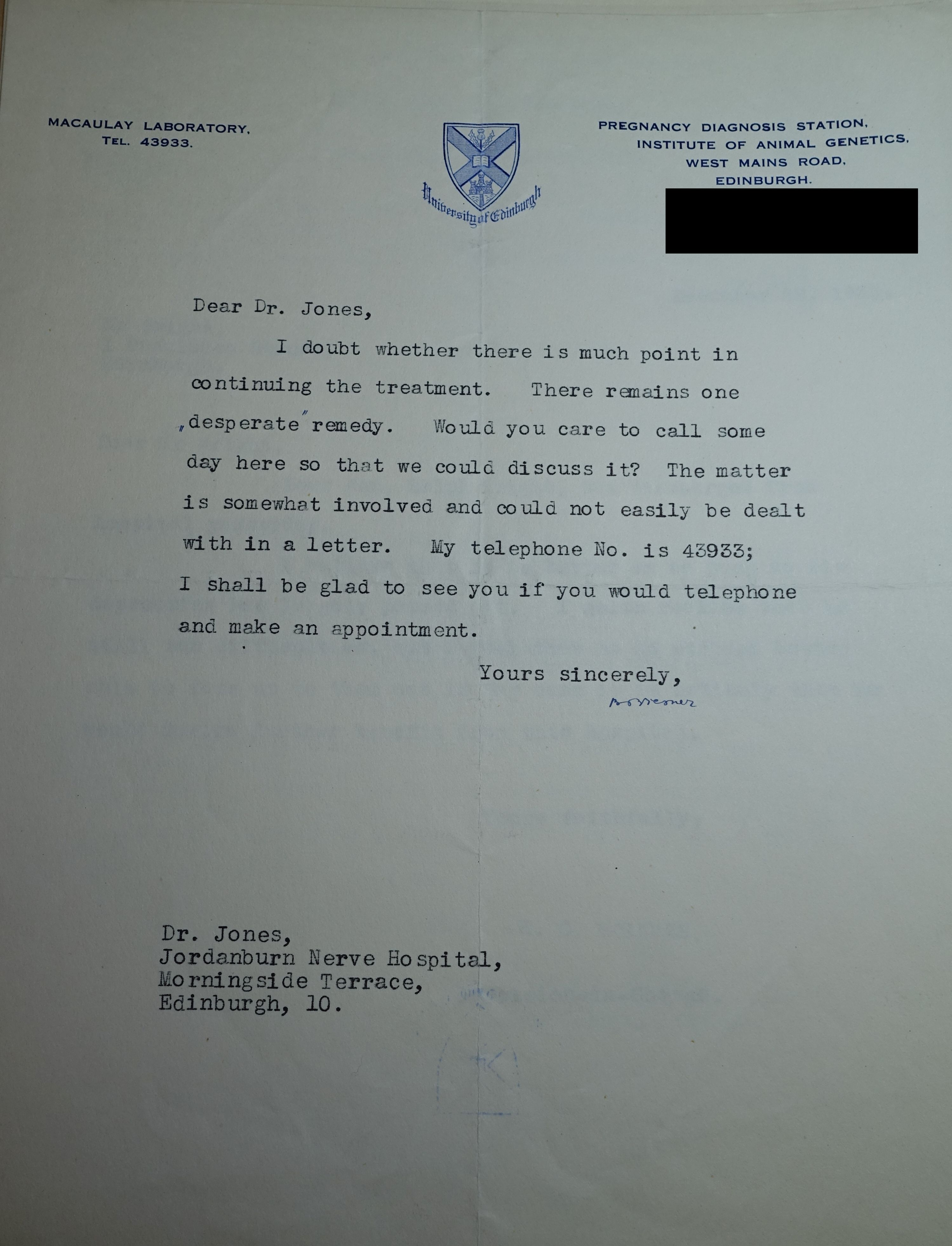
Wiesner writes back to say that there would be no benefit in continuing the treatment and states that ‘there remains one desperate remedy’ which he asks to discuss with Dr Jones on the phone as it is ‘rather involved’.

LHB7/CC1 extract from case note

What this remedy is can be gauged from a later document written by Jones. 

LHB7/CC1 - extract from case notes.  It would seem that Wiesner did not find any abnormality in the hormone content of David's blood. Wiesner debunks the effectiveness of testicular grafts for 'curing' or 'treating' homosexuality, instead believing that the 'direction of the sexual drive is dependant upon the anterior pituatory hormone'. He also stated that 'a certain control of the sexuality of rats is now possible by the use of anterior pituatory hormone or the surgical removal of the anterior part if the pituatory'. Wiesner also believed that in 'the next year or two it might be possible by the use of anterior pituatory hormone to control the sex drive sufficiently to make such a case socially adaptable'. 

The location of the Pituitary Gland (mispelt 'pituatory' in Dr Jones' case notes).

Wiesner therefore proposes two modes of treatment: the first being deep x-ray therapy of the sella turcica (where the pituitary gland is located). Wiesner admits this method is ‘not very scientific in that we did not understand exactly what might happen’. The second, ‘as advocated by Hirschfeld, no scientific method should be tried at all and the patient should be encouraged to practice overtly his aversion’. 

Wiesner mentions Magnus Hirschfeld (1868 – 1935) who was a German physician and a LGBT rights activist who set up the Institut für Sexualwissenschaft ('Institute of Sexual Research') in Berlin in 1919.

It's worth mentioning that JNH staff would adopt hormonal treatment on homosexuals at JNH later on in 1940s as Roger Davidson wrote in his paper Psychiatry and homosexuality in mid-twentieth-century Edinburgh: the view from Jordanburn Nerve Hospital:

In the late 1940s, Professor Henderson had collaborated with Derrick Melville Dunlop, Professor of Therapeutics at the University of Edinburgh, on research at the Royal Infirmary into the use of hormones in the treatment of homosexuality, following American reports of advances in this field. A group of JNH’s patients ‘who had proved resistant to psychiatric treatment and who were anxious to have their homosexual tendencies reformed’ had been referred to Dunlop. However, the results of the treatment had proved ‘completely negative’, although the therapy was claimed to have induced ‘marked feminine changes physically in practising sodomites.

During David’s first stint at JNH he decides to leave, and his case notes reveal the psychiatrist’s thoughts on his future wellbeing stating that although his ‘agitation’ has subsided ‘the outlook in a case like this is extremely grave’. The perceived gravity, according to the psychiatrist, was due to David’s ‘type’ of homosexuality which prevented him from ever becoming heterosexual. David’s hope for the future ‘lay in his ability to resign himself to such a situation and sublimate his energies’. 
What strikes me about this case is the psychiatrist believing that David will probably never get better because there was no chance he could ever ‘recover’ from his homosexuality. In the mid-1950s David was referred to JNH once more and the psychiatrist who examined him described him as a ‘long-standing homosexual, with features of inversion going well back into childhood’. In his mind, an ‘emotional adjustment seems barely possible in a man of his age with such history. The problem must be simply one of management. One cannot speak of cure.’ 

LHB7/CC1 extract from case note ater David's first admission. 'Patient left today of his own accord. He was advised to stay longer but this he refused to do'. 

The psychiatrisation of homosexuality is an extremely disturbing and poignant part of queer history. David was just one of the homosexual men who sought professional help for their mental health. It is deeply unsettling to read that, instead of getting the mental health support they much needed, the professionals they turned to would scrutinise and pathologise their sexuality. It is also upsetting to read the psychiatrist’s insistence that if these patients would simply ‘change’ or ‘manage’ their sexuality they could alleviate some of their mental suffering. 

The Lothian Gay and Lesbian Switchboard (the UK’s first gay helpline and Scotland's first gay charity) collection often provides some light and optimism when it comes to queer history and counteracts the disturbing and biased voice within some of our historic institutional records. 

The Lothian Gay and Lesbian Switchboard (LGLS) was a key source of support to LGBT+ people across Scotland and the UK. They campaigned and advised on sexual health, mental health, and equality issues, and worked with the NHS and Scottish Government in health education and social and economic research. LGLS provided a listening service and in-person befriending service to people struggling with issues or difficulties relating to their sexuality. Volunteers were available to listen to callers concerns as well as provide practical information, which included passing on details of gay-friendly organisations, counselling professionals, and sexual health advice.

The helpline was established after the gay rights organisation, the Scottish Minorities Group (SMG, founded in 1969) received a request from the Samaritans, who wanted to refer their clients to a specifically LGBT+ organisation. SMG also conducted an inquiry in their opening year, which looked into the views of people who were likely to be concerned with the gay community (including psychiatrists, social workers and clergy) to find out more about the social needs of homosexuals. The results confirmed that loneliness and isolation was the major problem facing homosexuals in Scotland at that time.

The below document found within the LGLS collection, dated 1978 (30+ years after David’s first admission, and a year after homosexuality was added to WHO’s list of International Classification of Diseases), shows how the Scottish Minorities Group were invited to provide a one-day workshop to staff at the Royal Edinburgh Hospital on Sexual Attitude Reassessment - which included a session on homosexuality. 

GD61/5/2/1 a one-day workshop on Sexual Attitude Reassessment held at the Royal Edinburgh Hospital, 27/05/1978.