Friday, 19 July 2019

Showing off (in a good way)!


We'd like the LHSA collections to be used even more by our colleagues across Edinburgh University, and last week we hosted a showcase event to promote the collections and introduce ourselves to people who hadn't heard about us before.

Invaluable help came in the form of Martyn Pickersgill, Wellcome Trust Reader at the Usher Institute's Centre for Biomedicine, Self and Society). Martyn worked with us to draw up an invite list and decide on the format for our showcase. We started off with a welcome to the Centre for Research Collections, where we are based, and then gave short presentations on the service as a whole, the collections we hold, and previous research use (and a big thank you to Gayle Davis, Senior Lecturer in the History of Medicine, for contributing the third and final presentation to the event). 

We also gave time over to a display that picked out the different record types in, and the topics covered by, the collections - a couple of pictures follow showing the display (along with Carmen our Employ.ed intern having a preview before everyone arrived!). Louise chose the items very carefully to help those attending see our collections in new ways and be inspired by the richness of the information held. It seems to have worked as a couple of the tweets that followed the event commented on how fascinating the material is and how there are "lots of exciting possibilities for research and teaching projects".


After a quick bite to eat we got the participants to work! We split them into three groups and asked each group to think about a question: what uses are there for LHSA collections? what else could we be collecting?, and who else could we invite to a showcase event? Everyone got stuck in and we had a great discussion and feedback session. 

The event has certainly sparked interest - 50% of those attending had an idea they would like to work with us on straight away, either using the collections for research or teaching, offering potential accessions, or helping with particular projects. This is a great result, especially as this is the first time we have run an event like this. But it won't be the last - do get in touch if you'd like to be involved in the next one!


Friday, 28 June 2019

RIE Oral Histories!


This week Access Officer Louise discusses the Royal Infirmary of Edinburgh Oral History Project…

At the start of May I began an eight month project to collect oral histories from people familiar with the Royal Infirmary of Edinburgh building at Lauriston Place. The project has been funded by the Edinburgh Futures Institute which will be based in the old hospital building from 2021. You can learn more about the EFI here:


The RIE Oral History project aims to capture memories from people who used the building when it was a hospital. The nature of people’s encounters with the building varied so greatly and hopefully this will be reflected in the project through a diverse range of participants. Potential interviewees could include members of staff (medical, support services, administration, etc.), former patients, volunteers and other healthcare professionals associated with the hospital.

Personal experiences provide evidence and a personal view that we cannot gain from paper records alone. These interviews will help future researchers understand the relationship people had, and still have, with the building.

LHB1/68/16 - David Bryce Plans for New Infirmary - Overlap on drawing on 81 of 21 June 1875 showing section of clock tower with chimneys.

Over the past couple of months I have been working hard to ensure that all my paperwork is in order, and that I have completed any relevant training. I spent some time listening to recordings that were taken as part of the pilot for this project which allowed me to think of potential questions for interviewees. I also attended an ‘Introduction to Oral History’ training day at the Scottish Oral History Centre, University of Strathclyde, which covered everything from project planning to consent and copyright. It also gave me a chance to practice interviewing and being interviewed. This exercise highlighted the importance of selecting your questions carefully so as to avoid leading and closed questions!

Aerial view of the Royal Infirmary of Edinburgh site at Lauriston Place


The next stage is the interviews themselves, and my diary for the next couple of months is already filling up with scheduled interviews and I hope to increase that number over the coming weeks – so I need you to spread the word!

The interviews will be relaxed and can be conducted individually or in groups. If you are interested in taking part, or know somebody who might be, please contact lhsa@ed.ac.uk or 0131 650 3392 for further information.

Thursday, 6 June 2019

Getting to grips with prosthetics!


This week, we hear from from Employ.ed on Campus intern, Carmen Hesketh, following her first week with LHSA. Employ.ed on Campus is a scheme for current students of the University of Edinburgh offering paid work experience in a variety of exciting projects throughout the University, including here in the Centre for Research Collections!

My name is Carmen and I will be working for the next 10 weeks on the collection of bio-engineer David Gow here at Lothian Health Services Archive (LHSA).

Carmen hard at work already!
I am a third year History student here at the University of Edinburgh, and since I began my studies I have tried my best to be actively involved in heritage work in this beautiful city. I began volunteering with LHSA at the end of my first year and have worked on a variety of projects, including recording Victorian mental health patient cases from the Royal Edinburgh Hospital; cataloguing oral history projects relating to HIV and AIDS in Edinburgh during the 1980s; and cataloguing collections related to family planning and sex education in the 1970s. These projects, along with my volunteering role at The Royal College of Physicians of Edinburgh where I transcribed oral history interviews of prominent post-war doctors, has made me realise that I am passionate about medical and disability history, which has influenced my academic study. For example, next year I plan on writing my undergraduate dissertation on how museum collections represent the history of HIV and AIDS in Scotland. This is one of the many reasons why I am delighted to have the chance to do this internship with LHSA - I am getting the chance to develop my knowledge on a research area that I am extremely enthusiastic about, as well as having the opportunity to create an online resource to make such an important topic known to the public. 

As well as working with medical collections, I have also been involved in heritage outreach through my job at The Museum on the Mound where I give presentations on the history of money to schoolchildren and through a previous internship helping to coordinate Doors Open Days, Scotland’s largest free architectural heritage festival. Heritage education is something that I have always loved being a part of and I think that this internship will be fantastic in helping me further improve my skills in this area.

Over the next few weeks, I will be examining the collection donated to LHSA by Dr David Gow. This collection contains records from the Bio-engineering Centre, which was a department located in the Princess Margaret Rose Orthopaedic Hospital, opened in the 1960s in order to cater to the needs of children who suffered from severe limb deficiencies as a result of the Thalidomide tragedy. Initially, bio-engineers at the Centre, led by Dr (later Professor) David Simpson, were pioneers in pneumatic powered prostheses – they created prostheses which were powered by gas and air because batteries at the time were too heavy to be used as a power source for artificial limbs. They served around 60 children who needed upper limb prostheses and supported them until young adulthood, and as well as creating upper limb prostheses. They also invented aids which could support patients in their daily lives: the most notable example being the Simpson-Edinburgh Low Pressure Airbed which was developed in the 1970s and effectively prevented pressure sores for those with disabilities.

Professor Simpson's Low Pressure Air-bed
Dr David Gow was appointed Director of the Centre in 1986, and shifted from pneumatic powered devices to develop electrically powered prostheses because he believed that they were more user-friendly and convenient. In 1998, Dr Gow and his team created and fitted the first complete electrically powered arm prosthesis, known as the Edinburgh Modular Arm System (EMAS), and in 2007, he created the i-limb, the first prosthetic hand to have independently powered articulating fingers. It will be my job to create an online resource about a variety of themes relating to the collection, cataloguing items relating to the collection on the University’s online database, and interview Dr David Gow himself to create an oral history testimony about his contribution to the field.


Examples of prostheses (note finger sleeves on top image) created by the Bio-engineering Centre
Since researching the collection, I have been fascinated by how much impact the Bio-engineering Centre in Edinburgh has had on patients all over the world, and how Edinburgh bio-engineers have actively created equipment as well as prostheses to make life easier for their patients. I am also excited to meet Dr Gow personally and have the opportunity to interview him about his thought processes and inspirations for creating a device that is so invaluable to its users. Overall, I can’t wait to see what the next few weeks have in store!

Friday, 26 April 2019

Beyond the conventions

This week, Archivist Louise looks at some 'alternative' themes in LHSA collections...

Even after five years as archivist at LHSA, I'm always reminded of how varied our collections actually are - either by working with something I have not physically seen before, or re-visiting material for a researcher. In the past month or so, I've been helping an Edinburgh postgraduate student explore one of our collections for a report she's writing. This was, in fact, the first collection I ever catalogued at LHSA, that of osteopath, iridologist (stay with me!) and medical masseuse, Amelia Nyasa Laws. The student's project involves exploring Amelia's papers, and looking into the reasons behind how they're described and stored.

Until I looked at the papers again, I'd forgotten what a diverse career Amelia had. Daughter of Scottish medical missionary Robert Laws, Amelia (1886 - 1978) worked as a medical masseuse in France during the First World War, took her degree in medicine in Edinburgh, and trained in the Royal Infirmary of Edinburgh in orthopaedics, later travelling to Europe to add to her orthopaedic and physiotherapy training. Amelia eventually became an osteopath as her main profession (a therapist who aims to detect, prevent and treat medical problems by moving and stretching muscles and joints). However, her interests were wide and varied, as shown by the archive that we hold for her.

For example, she was a follower of iridology in the 1920s and 1930s, a (now discredited) field that claimed to diagnose medical problems through the study in changes in the iris of the eye:

A 1926 pamphlet on iridolgy. Amelia's cosmopolitan education meant that she collected resources in multiple languages.
From her training in the 1920s to her retirement in the 1970s, Amelia had a demonstrable interest in other (what we'd now call) 'alternative therapies'. Amelia's pamphlet collection shows her actively exploring and collecting material on a number of issues. For example, in the 1960s, she looked into 'Rolfing'  (a system of manipulation invented by American Ida Rolf):


A pamphlet on 'Rolfing', which traditionally structured treatment around ten sessions.

... and 'naturopathy', which believes in stimulating the body's responses through diet, herbs, sun and fresh air:


Thanks to Amelia's research into alternative medicine, we also have pamphlets on homeopathy:


.. and this 1936 pamphlet on the benefits of comfrey:


It's clear from the letters that came with some of this literature that a lot of the time Amelia was asking for information from manufacturers and organisations in response to particular patient conditions, as shown on pamphlets she collected in the 1940s into possible cancer treatments:


It's been really interesting to look back at this varied material - I love finding things that you wouldn't necessarily expect to come across in an archive like ours! The debates on 'alternative medicine' these days are ongoing, heated and understandably emotive - and I'm sure we all have our views on them! But whatever side of the fence you happen to fall upon, it's fascinating to look back through the ways in which these therapies were promoted and disseminated, and to find out about an individual like Amelia who was looking genuinely far and wide to find solutions to her patients' needs.

Friday, 29 March 2019

Creative Writing and Archive Records!

In this week's post Access Officer Louise shares her experience of hosting a creative writing workshop...


Last month, as part of the Festival of Creative Learning, I helped run a creative writing workshop that invited students to learn about the history of the Royal Edinburgh Hospital and to write poems and short stories using archival records as their inspiration.

I was fortunate enough to be joined on the day by Ellen and Natalie from the University of Edinburgh’s creative writing and publishing society PublishED. Ellen and Natalie were a tremendous help and took over when it came to the creative aspect of the day by producing a series of tasks designed to get everyone in the creative mindset.

We started the day by asking groups to list words that they associate with asylums and had an open discussion about what they perceived to be the treatment of mental illness in the Victorian era.


I then provided some context and discussed what we can learn about the conditions and treatment of patients within the Royal Edinburgh Hospital from the collection held within our archive.

We looked at a variety of records including photographs of the building interiors/exteriors, patient photographs, letters and clinical records as well as extracts from the patient magazine the Morningside Mirror.


To kick start the creativity Ellen and Natalie led two short exercises designed to get everyone writing (including myself and our recent intern Emma). The first of these was to write a bad poem in one minute using nouns picked out from the following picture showing a hallway within Craig House:


A number of people were brave enough to share with the rest of the group what they had written (and it was at that point that I realised that only I had written a truly bad poem).

As well as sharing out loud with the group some people were also kind enough to leave their writing behind and I have included some extracts below:

Others shoot and hit, yet I am always falling short,
not cut out for any sport which follows precise lines.
I take comfort in the ice the brilliance of crystals
perched against one another, stacked close,
like cell mates joined in the suspended flow.


Asylum Photographer

Stand still. Please allow me to capture you,
Let me take those harrowed eyes, that sour frown,
Move not, lest you blur in time and in mind,
Suppress those shivers; please dull down your twitch,
Talk not, the shutter retains no sound


My friends,
The time has come. The days are short and the odds are long but let me be clear: there will be no miracles here. We have long been told that change is coming, long held out for change that is coming, long put faith in change forthcoming. Change will come when we create it. A system built to subdue and divide us cannot stand if we do.
They want to keep us hidden because we do not conform to their definition of “normal”. Because we do not conform to what is acceptable. Who are they? The rich? The educated? The powerful? Why should they be the gatekeepers of society, of what is normal, of what is allowed.


The feedback from the event was very positive and as it was my first writing event I asked people to comment on what worked and what didn’t work so that we can put on a similar and even better event in the future!

Friday, 15 March 2019

Hospital for the future

This week, Archivist Louise has been thinking about the architecture of healthcare...

On Tuesday, staff members from the University of Edinburgh Centre for Research Collections (of which we're part) were lucky enough to enjoy a guided tour of Historic Environment Scotland. The organisation came into being after the merger of Historic Scotland and the Royal Commission on the Ancient and Historical Monuments of Scotland in 2015. Nowadays, you are probably more familiar with seeing the Historic Environment Scotland logo on the many historic properties it manages around the country, but few people realise that the organisation also holds a substantial paper, photographic and artefact record of our shared built heritage - and that you can access these fantastic resources both in person in their searchroom on Bernard Terrace and online through their impressive set of resources. I often use Canmore, an online database of records about buildings, archaeology and maritime history, to search for images of now-demolished hospital sites, for example. This week has seen the anniversary of the death of John Astley Ainslie, whose fortune later helped to establish the Astley Ainslie Hospital, which opened in 1923. We don't have many images of the hospital, but I can look up a range of views on Canmore, here.

Wartime patients at Astley Ainslie, from our own collections, which tend to focus more on the hospital's atmosphere than its architecture!
During the tour, our group was ably led by Archivist Lesley Ferguson, who guided us up from the strongrooms to Historic Environment Scotland's impressive digital imaging and scanning facilities. We also were able to view a range of items from the archives in the public searchroom. One of these was a watercolour of a now-demolished building by David Bryce, Craigends House.

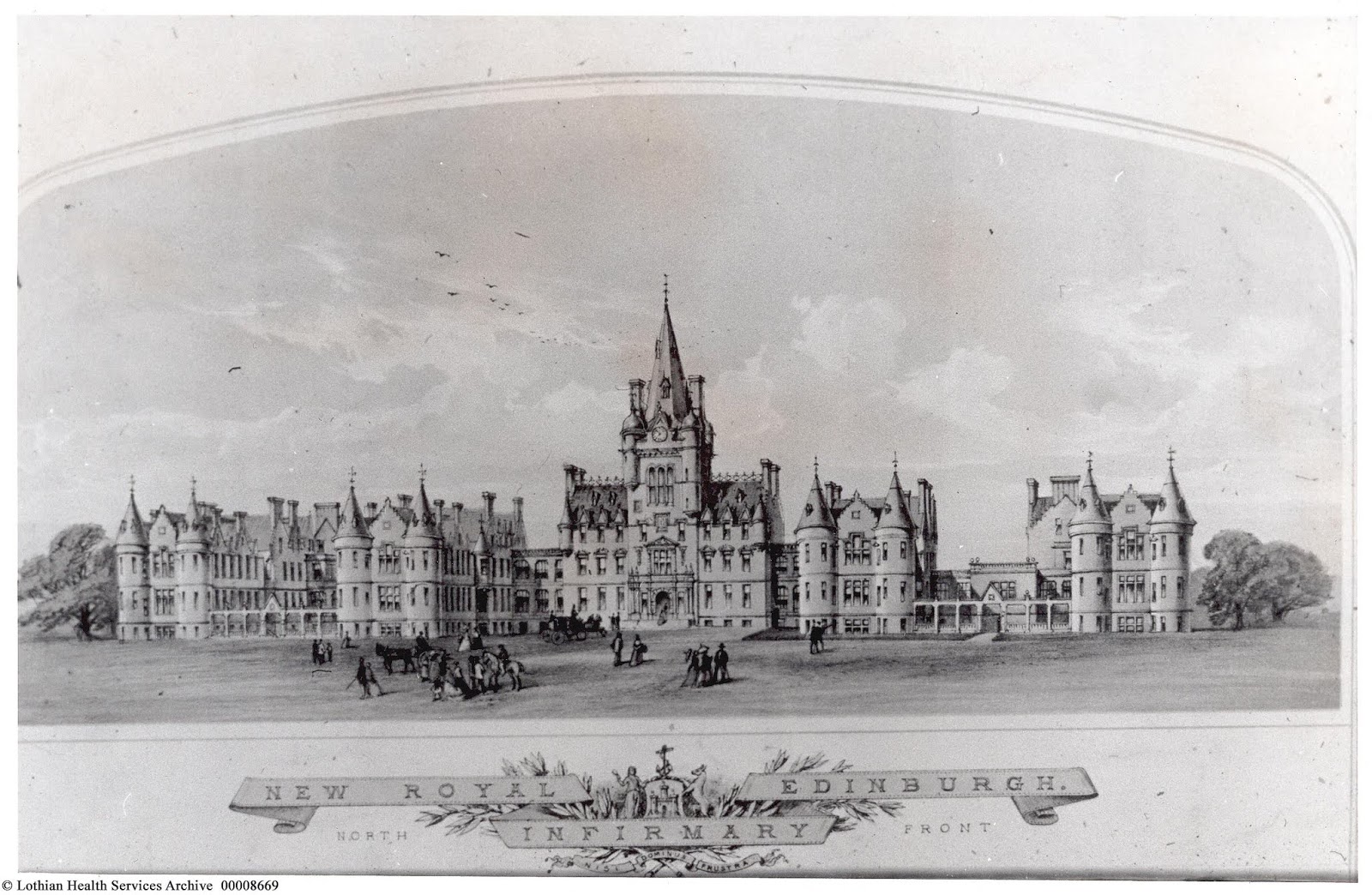
David Bryce, of course, also designed the Royal Infirmary building, which opened in 1879 on Lauriston Place. It replaced the eighteenth century Infirmary in High School Yards, designed by William Adam. We have quite a few images of both buildings, which you can compare below.

William Adam Infirmary, opened in 1741

David Bryce-designed Royal Infirmary, opened in 1879
Just as the William Adam Infirmary was no-longer fit for purpose as the nineteenth-century wore on, the Lauriston Place site was struggling to keep pace with modern medicine as the twentieth century drew to a close. In the 1990s, plans began to be made to move to a new hospital in Little France to the south-east of the centre of Edinburgh, which would combine services from many of the city's nineteenth century local hospitals. When a building like the Bryce Infirmary closes its doors, Historic Environment Scotland spring into action, and in 2003, the (then) Royal Commission on the Ancient and Historical Monuments of Scotland surveyed the interior of the buildings, and we hold copies of the photographs from the survey in LHSA collections. Back then, the future of the building was uncertain, so it was important to record the building at the end of its life as a hospital.

During its lifetime, the Lauriston Place Infirmary was extended, and more pavilions were built in order to accommodate more patients and different specialisms. We have plans of these changes (and of the original Bryce designs) in our collections:

Proposed elevation for the Lauriston Place Infirmary
We are lucky to hold such a substantial record of the physical appearance of the Lauriston Place site, particularly since so much of it has been either recently redeveloped or demolished, since not all later additions were listed. While many of the surviving buildings form part of the Quartermile development, the listed old hospital building remained unoccupied.

The clock tower in the 1980s
Now, though, the Infirmary is about to see a whole new life. The University of Edinburgh has purchased the building, and it is to be developed into an interdiscipliniary teaching and learning space, where partnerships with the local community, organisations and enterprises can be explored. LHSA has been involved with these changes from a fairly early stage, as the University is keen to reflect the building's heritage in its future use as the Edinburgh Futures Institute. For example, as in the motto written above the Infirmary's door - patet omnibus - the new Edinburgh Futures Institute will be open to all.

LHSA Manager Ruth was also out and about this week, and on Monday attended a tour of the Infirmary site as it is being developed into the Futures Institute.The tour was also attended by former nurses who trained and worked at the Infirmary - members of the Pelican League. The exterior of the building is being given a thorough overhaul, as can be seen by this shiny section:


Ruth also saw the workings of the Infirmary's clock up close:


The old Bryce Infirmary is an iconic building in Edinburgh not only for its architectural merit, but for its place in people's lives, as it witnessed births, deaths and opportunities for a second chance within its walls. This past is being acknowledged in the building's redevelopment, with the original, Nightingale wards (wards with plenty of space for air circulation, with big windows and long walls along which beds were placed):

A Nightingale ward in the process of transformation

Friday, 1 March 2019

...intern Emma discusses 19th century language!


Hello again! I’m coming to the end of my internship at LHSA and after cataloguing and rehousing the collection of John Home’s letters I have spent the last few weeks transcribing them, which has been an interesting and immersive experience.

As well as the challenge of familiarising myself with some occasionally illegible 19th century handwriting, I have been learning about transcribing practice. When transcribing you should replicate the material exactly as initially written, including all spellings and punctuation, although expanding contracted words or indicating misspellings to assist the reader is common practice. It soon becomes clear that built in auto-formatting, which can be so useful, is not your friend when it comes to transcribing. The concentration required is considerable as is the degree of double and triple-checking required. Thank goodness for tea!

But what if once you’ve deciphered the handwriting, you still can’t understand the content? Although most of the letters are written in English similar to that used today, I also came across phraseology that was of its time or particular to John Home’s profession. He was a Writer to the Signet and so was familiar with legal terminology that probably wasn’t widely used then or now. It took quite a bit of time and internet research to work my way through all of the letters to fully understand their meaning.

As anyone who knows me well will confirm, I am a huge fan of a quiz, so I couldn’t let an opportunity pass to set a few questions to the readers of this blog on whether they would have found the letters easier to understand than I did. Answers at the end, no prizes though I’m afraid!

1. What is a roup?
2. And a tapis?
3. What kind of judge is a ‘Puisne’ judge (and how do you pronounce it)?
4. When would you use ‘yclept’?
5. If something is ‘clamant’, what does that mean?
6. What is someone who is ‘bounden’?
7. Where would you find a ‘po’?
8. And finally, what are ‘whole parts pendicles privileges and pertinents’?

Looking at the collection as a whole, there were 174 letters from John Home to 68 different recipients including seven to unnamed individuals, Grouping them by theme, the letters addressed members of the legal profession, business associates, romantic interests, friends, newspapers, publishers, medical professionals, family members and there were 19 letters specifically to Dr Thomas Clouston, the Medical Superintendent at the Royal Edinburgh Asylum at the time of John Home’s residence there.

The letters to family members and to Dr Clouston frequently took an insulting tone , which veered from mild irritation and jibes to what he would have himself described as ‘most unparliamentary language’ and fairly serious threats of physical violence. He had a colourful and creative turn of phrase, particularly impressive considering the context and content of the letters.  I’ve included a few of his more entertaining insults below.

GD16/2/6/1/44 - John Home to Mrs Edmondstoune

“… and when I leave this cursed place I shall hire a bad woman to follow you about and insult you as I intend to do with you the wife of the wooden headed non entity who presides here”

GD16/2/6/1/105 – John Home to Miss Rintoul
“I intend to prosecute Clouston both civilly and criminally and to hire a man to thrash him. He is the most infernal liar and the most utter scoundrel and blackguard that ever drew breath. Entre nous I believe he drinks like a fish. His wife also I fancy is not better than she ought to be”


GD16/2/6/1/49 – John Home’s account of his experiences
“a very weak brother who never had any private practice and whose Cousin sells pots and pans….”


John Home’s use of language has made working with the collection a real joy, as well as interesting and informative. From eight weeks immersed in his writings, I now feel as though I know something of his character and will be sorry to leave him behind.


Quiz answers

1. A roup is an auction, commonly relating to property sales.
2. A tapis is a tapestry or richly decorated cloth, used as a hanging or a covering, or a small carpet.
3. A Puisne judge is a junior judge, without distinction or title.
4. Yclept means, ‘by the name of’, e.g. a man yclept John
5. Something that is ‘clamant’, is something that urgently needs attention.
6. Someone who has a ‘bounden’ duty has a responsibility or obligation, e.g. to help.
7. A ‘po’ is another word for chamber pot, so could be found in the bathroom or bedroom.
8. ‘whole parts, pendicles, privileges and pertinents’ – these are terms from Scots Law in relation to parts or things pertaining to a property and are used in transfers of land or property.